Future Trends in Hydro Testing Equipment and High-Pressure Pumps
Introduction
As industries continue to demand higher levels of safety, efficiency, and reliability, hydro testing equipment and high-pressure pumps are evolving rapidly. From oil & gas pipelines and pressure vessels to boilers, heat exchangers, and industrial components, hydrostatic testing remains a critical process for ensuring structural integrity and operational safety.
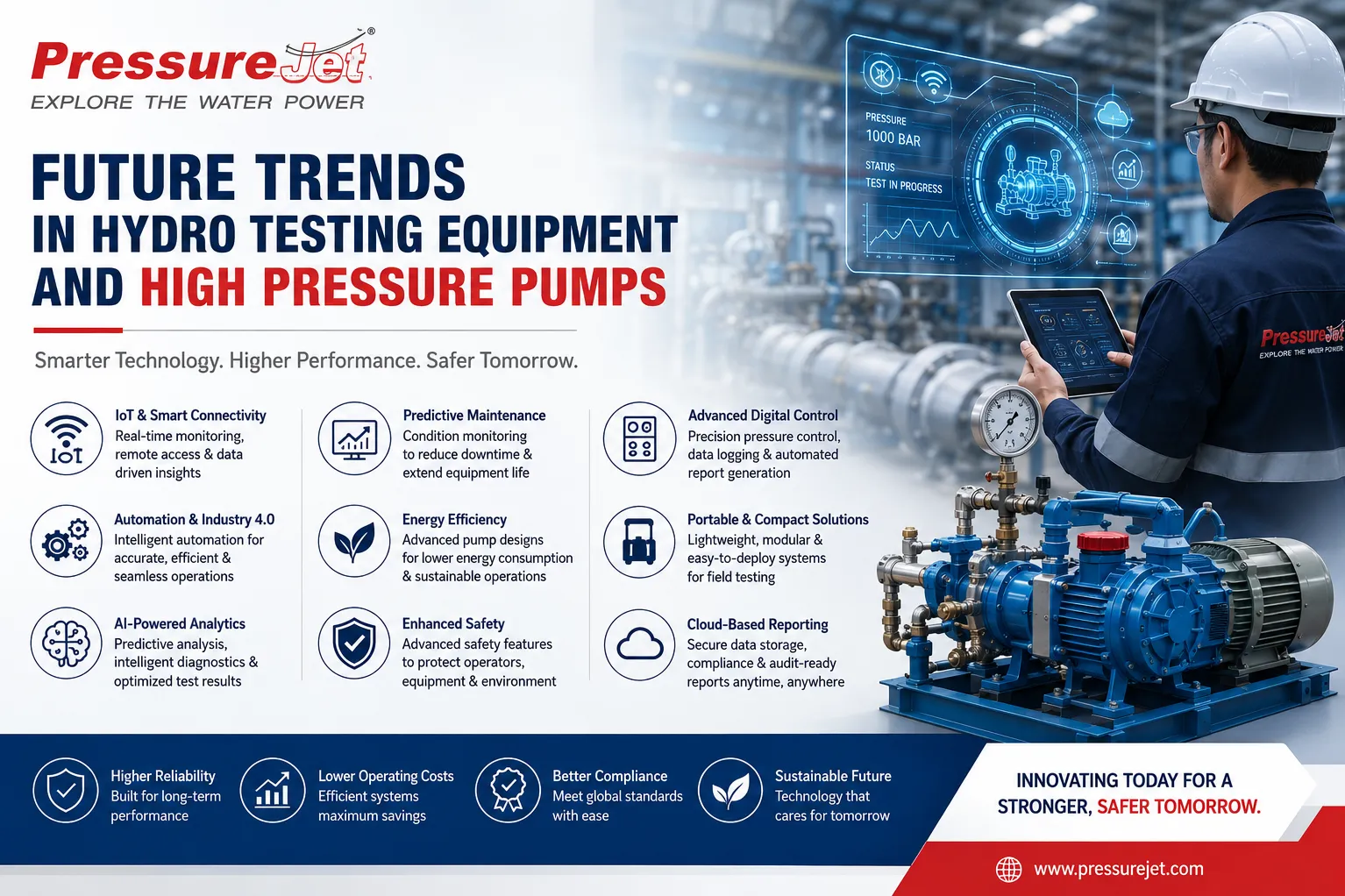
Emerging technologies such as automation, IoT connectivity, predictive maintenance, and energy-efficient pump designs are reshaping the future of hydro testing systems. Companies seeking improved productivity and compliance are increasingly investing in next-generation hydro testing solutions that offer greater accuracy, reduced downtime, and enhanced operational control.
In this article, we explore the key trends that are expected to define the future of hydro testing equipment and high-pressure pumps.
1. Smart Hydro Testing Systems with IoT Integration
The Industrial Internet of Things (IIoT) is transforming traditional testing equipment into intelligent systems capable of real-time monitoring and diagnostics.
Key Benefits:
Remote monitoring of pressure, flow, and test parameters
Real-time data logging and reporting
Instant alerts for abnormal operating conditions
Improved traceability and compliance documentation
Future hydro test pumps will increasingly feature built-in sensors and cloud connectivity, allowing operators to monitor performance from anywhere while maintaining complete test records.
2. Automation and Industry 4.0 Adoption
Automation is becoming a major focus across manufacturing and testing operations.
Emerging Features:
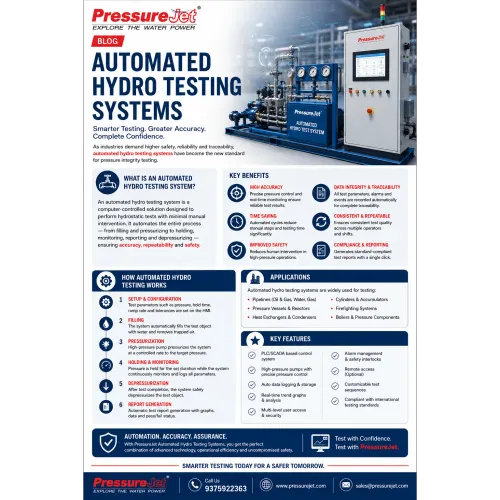
Automated pressure ramp-up and ramp-down cycles
Programmable testing sequences
Automated leak detection
Integrated pass/fail reporting systems
Reduced operator intervention
Industry 4.0-enabled hydro testing systems can communicate with manufacturing execution systems (MES) and plant management software, creating seamless workflows and reducing human error.
3. Predictive Maintenance Technologies
Unexpected equipment failures can result in costly downtime and delayed production schedules.
Future hydro testing equipment will increasingly utilize:
Vibration monitoring
Temperature sensing
Pressure trend analysis
AI-based condition monitoring
These technologies help predict component wear before failures occur, enabling proactive maintenance and extending equipment life.
Advantages:
✔ Lower maintenance costs
✔ Reduced downtime
✔ Increased equipment reliability
✔ Longer service life
4. Energy-Efficient High-Pressure Pumps
Energy consumption remains a significant operational expense in industrial testing applications.
Manufacturers are developing:
High-efficiency motor technologies
Variable Frequency Drives (VFDs)
Optimized hydraulic designs
Energy recovery systems
These advancements reduce power consumption while maintaining required pressure levels, helping organizations achieve sustainability goals and lower operating costs.
5. Digital Pressure Control and Precision Testing
Modern industries require increasingly accurate testing procedures.
Future systems will feature:
Advanced Digital Controls
Touchscreen interfaces
Electronic pressure regulation
Multi-stage testing profiles
Precision pressure holding capabilities
Benefits:
Improved test accuracy
Consistent repeatable results
Enhanced product quality
Easier compliance with industry standards
Digital control systems eliminate many variables associated with manual testing operations.
6. AI-Powered Test Analysis
Artificial Intelligence is beginning to play a significant role in industrial testing processes.
Future hydro testing equipment may include AI-driven capabilities such as:
Automatic leak pattern recognition
Failure prediction models
Test result optimization
Intelligent troubleshooting recommendations
AI can analyze thousands of test records to identify trends that may not be visible through conventional methods.
7. Portable and Compact Testing Solutions
Industries increasingly require field-based testing for pipelines, pressure vessels, and remote installations.
Future Equipment Characteristics:
Lightweight designs
Compact footprints
Battery-assisted operation
Modular construction
Quick deployment capabilities
Portable hydro testing units will continue to gain popularity, particularly in oil & gas, construction, marine, and infrastructure sectors.
8. Enhanced Safety Features
Safety remains the highest priority in high-pressure applications.
Future hydro test systems will incorporate:
Advanced Safety Technologies
Automatic emergency shutdown systems
Pressure relief mechanisms
Remote operation capabilities
Safety interlocks
Real-time hazard detection
These innovations help protect both personnel and equipment while reducing operational risks.
9. Sustainable and Environmentally Friendly Designs
Environmental regulations are encouraging manufacturers to develop greener testing solutions.
Sustainability Trends:
Reduced water consumption
Closed-loop water recycling systems
Environmentally friendly hydraulic fluids
Energy-efficient motors
Lower carbon footprint designs
Organizations are increasingly selecting equipment that aligns with environmental compliance and sustainability initiatives.
10. Advanced Data Management and Cloud Reporting
Documentation requirements continue to grow across industries.
Future hydro testing equipment will provide:
Cloud-based test storage
Automated report generation
Digital signatures
Regulatory compliance tracking
Remote audit support
Digital recordkeeping improves transparency while simplifying quality assurance and regulatory inspections.
Industries That Will Benefit Most
The adoption of advanced hydro testing technologies will significantly impact:
Oil & Gas
Power Generation
Chemical Processing
Petrochemical Plants
Aerospace Manufacturing
Shipbuilding
Pressure Vessel Manufacturing
Pipeline Construction
Industrial Equipment Manufacturing
These sectors require reliable testing systems capable of meeting stringent safety and quality standards.
Challenges Ahead
Despite rapid technological advancements, some challenges remain:
Initial investment costs
Cybersecurity concerns for connected equipment
Workforce training requirements
Integration with legacy systems
Compliance with evolving industry standards
Manufacturers and end-users must work together to maximize the benefits of emerging technologies while managing these challenges effectively.
Conclusion
The future of hydro testing equipment and high-pressure pumps is being shaped by automation, digitalization, artificial intelligence, and sustainability. Smart connected systems, predictive maintenance capabilities, advanced pressure control, and energy-efficient designs are transforming how industries conduct hydrostatic testing.
Organizations that embrace these innovations will benefit from improved reliability, enhanced safety, reduced operating costs, and greater testing accuracy. As Industry 4.0 continues to evolve, hydro testing equipment will become smarter, more efficient, and increasingly integrated into the broader digital manufacturing ecosystem.
Introduction
As industries continue to demand higher levels of safety, efficiency, and reliability, hydro testing equipment and high-pressure pumps are evolving rapidly. From oil & gas pipelines and pressure vessels to boilers, heat exchangers, and industrial components, hydrostatic testing remains a critical process for ensuring structural integrity and operational safety.
Emerging technologies such as automation, IoT connectivity, predictive maintenance, and energy-efficient pump designs are reshaping the future of hydro testing systems. Companies seeking improved productivity and compliance are increasingly investing in next-generation hydro testing solutions that offer greater accuracy, reduced downtime, and enhanced operational control.
In this article, we explore the key trends that are expected to define the future of hydro testing equipment and high-pressure pumps.
1. Smart Hydro Testing Systems with IoT Integration
The Industrial Internet of Things (IIoT) is transforming traditional testing equipment into intelligent systems capable of real-time monitoring and diagnostics.
Key Benefits:
Remote monitoring of pressure, flow, and test parameters
Real-time data logging and reporting
Instant alerts for abnormal operating conditions
Improved traceability and compliance documentation
Future hydro test pumps will increasingly feature built-in sensors and cloud connectivity, allowing operators to monitor performance from anywhere while maintaining complete test records.
2. Automation and Industry 4.0 Adoption
Automation is becoming a major focus across manufacturing and testing operations.
Emerging Features:
Automated pressure ramp-up and ramp-down cycles
Programmable testing sequences
Automated leak detection
Integrated pass/fail reporting systems
Reduced operator intervention
Industry 4.0-enabled hydro testing systems can communicate with manufacturing execution systems (MES) and plant management software, creating seamless workflows and reducing human error.
3. Predictive Maintenance Technologies
Unexpected equipment failures can result in costly downtime and delayed production schedules.
Future hydro testing equipment will increasingly utilize:
Vibration monitoring
Temperature sensing
Pressure trend analysis
AI-based condition monitoring
These technologies help predict component wear before failures occur, enabling proactive maintenance and extending equipment life.
Advantages:
✔ Lower maintenance costs
✔ Reduced downtime
✔ Increased equipment reliability
✔ Longer service life
4. Energy-Efficient High-Pressure Pumps
Energy consumption remains a significant operational expense in industrial testing applications.
Manufacturers are developing:
High-efficiency motor technologies
Variable Frequency Drives (VFDs)
Optimized hydraulic designs
Energy recovery systems
These advancements reduce power consumption while maintaining required pressure levels, helping organizations achieve sustainability goals and lower operating costs.
5. Digital Pressure Control and Precision Testing
Modern industries require increasingly accurate testing procedures.
Future systems will feature:
Advanced Digital Controls
Touchscreen interfaces
Electronic pressure regulation
Multi-stage testing profiles
Precision pressure holding capabilities
Benefits:
Improved test accuracy
Consistent repeatable results
Enhanced product quality
Easier compliance with industry standards
Digital control systems eliminate many variables associated with manual testing operations.
6. AI-Powered Test Analysis
Artificial Intelligence is beginning to play a significant role in industrial testing processes.
Future hydro testing equipment may include AI-driven capabilities such as:
Automatic leak pattern recognition
Failure prediction models
Test result optimization
Intelligent troubleshooting recommendations
AI can analyze thousands of test records to identify trends that may not be visible through conventional methods.
7. Portable and Compact Testing Solutions
Industries increasingly require field-based testing for pipelines, pressure vessels, and remote installations.
Future Equipment Characteristics:
Lightweight designs
Compact footprints
Battery-assisted operation
Modular construction
Quick deployment capabilities
Portable hydro testing units will continue to gain popularity, particularly in oil & gas, construction, marine, and infrastructure sectors.
8. Enhanced Safety Features
Safety remains the highest priority in high-pressure applications.
Future hydro test systems will incorporate:
Advanced Safety Technologies
Automatic emergency shutdown systems
Pressure relief mechanisms
Remote operation capabilities
Safety interlocks
Real-time hazard detection
These innovations help protect both personnel and equipment while reducing operational risks.
9. Sustainable and Environmentally Friendly Designs
Environmental regulations are encouraging manufacturers to develop greener testing solutions.
Sustainability Trends:
Reduced water consumption
Closed-loop water recycling systems
Environmentally friendly hydraulic fluids
Energy-efficient motors
Lower carbon footprint designs
Organizations are increasingly selecting equipment that aligns with environmental compliance and sustainability initiatives.
10. Advanced Data Management and Cloud Reporting
Documentation requirements continue to grow across industries.
Future hydro testing equipment will provide:
Cloud-based test storage
Automated report generation
Digital signatures
Regulatory compliance tracking
Remote audit support
Digital recordkeeping improves transparency while simplifying quality assurance and regulatory inspections.
Industries That Will Benefit Most
The adoption of advanced hydro testing technologies will significantly impact:
Oil & Gas
Power Generation
Chemical Processing
Petrochemical Plants
Aerospace Manufacturing
Shipbuilding
Pressure Vessel Manufacturing
Pipeline Construction
Industrial Equipment Manufacturing
These sectors require reliable testing systems capable of meeting stringent safety and quality standards.
Challenges Ahead
Despite rapid technological advancements, some challenges remain:
Initial investment costs
Cybersecurity concerns for connected equipment
Workforce training requirements
Integration with legacy systems
Compliance with evolving industry standards
Manufacturers and end-users must work together to maximize the benefits of emerging technologies while managing these challenges effectively.
Conclusion
The future of hydro testing equipment and high-pressure pumps is being shaped by automation, digitalization, artificial intelligence, and sustainability. Smart connected systems, predictive maintenance capabilities, advanced pressure control, and energy-efficient designs are transforming how industries conduct hydrostatic testing.
Organizations that embrace these innovations will benefit from improved reliability, enhanced safety, reduced operating costs, and greater testing accuracy. As Industry 4.0 continues to evolve, hydro testing equipment will become smarter, more efficient, and increasingly integrated into the broader digital manufacturing ecosystem.
Keywords