As industries increasingly demand higher levels of safety, accuracy, traceability, and operational efficiency, automated hydro testing systems are transforming the way pressure integrity testing is performed.
Traditional hydro testing often requires operators to manually control filling, pressurization, pressure holding, monitoring, depressurization, and data recording. An automated hydro testing system integrates these functions into a controlled sequence, reducing manual intervention and delivering consistent and repeatable test results.
For applications such as pipelines, pressure vessels, heat exchangers, cylinders, boilers, valves, and other pressure-containing equipment, automation can significantly improve both testing efficiency and documentation.
What Is an Automated Hydro Testing System?
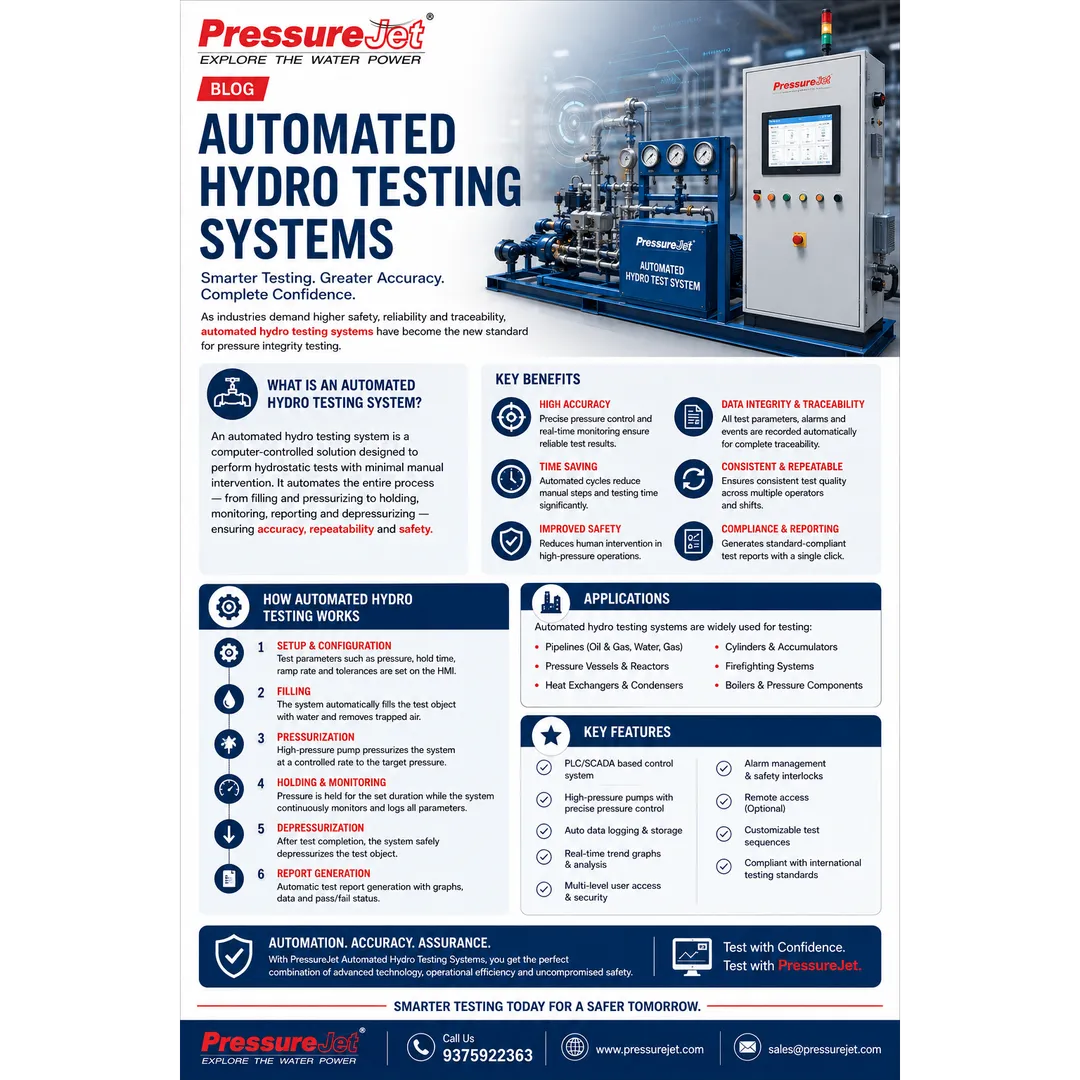
An automated hydro testing system is a computer-controlled pressure testing package designed to execute a predefined hydrostatic test sequence with minimal manual intervention.
Depending on the application, the system can automatically control and monitor:
Water filling
Air removal
Pressure build-up
Pressure stabilization
Pressure holding
Pressure monitoring
Controlled depressurization
Data acquisition
Test result evaluation
Automatic test report generation
The operator can configure test parameters through an HMI (Human-Machine Interface) or industrial control system before initiating the test.
Why Industries Are Moving Toward Automated Hydro Testing
Manual testing can involve multiple operator-controlled steps and considerable paperwork. When a facility performs hundreds or thousands of tests, maintaining consistent procedures and accurate records becomes increasingly challenging.
Automation helps address these challenges by providing:
1. High Testing Accuracy
Automated pressure control allows the system to approach and maintain the specified test pressure more precisely.
2. Consistent Test Procedures
The same programmed test sequence can be repeated across multiple components, reducing variations caused by different operators or shifts.
3. Reduced Testing Time
Automated filling, pressurization, monitoring, and reporting can reduce manual activities and improve overall testing productivity.
4. Improved Safety
Automation reduces the need for operators to remain close to high-pressure equipment during critical stages of the test.
5. Automatic Data Recording
Important test parameters can be recorded electronically, including:
Test pressure
Pressure versus time
Holding duration
Test cycle information
Alarms and events
Pass/fail status
6. Complete Traceability
Digital test records make it easier to track individual components and demonstrate that the required testing procedure has been completed.
7. Faster Report Generation
Automated systems can generate test reports containing recorded pressure curves, test parameters, date/time information, and test results.
How Does an Automated Hydro Testing System Work?
A typical automated hydro testing sequence consists of the following stages.
Step 1: Setup & Configuration
The operator selects or enters the required test parameters through the control panel/HMI, such as:
Test pressure
Ramp rate
Holding time
Pressure tolerance
Depressurization parameters
Test identification
The exact parameters depend on the applicable code, specification, and approved test procedure.
Step 2: Filling
The test component is filled with water.
The system can control filling and, where configured, assist with air removal to prepare the test object for pressurization.
Step 3: Pressurization
The high-pressure pump increases pressure in a controlled manner until the specified test pressure is reached.
Automated control can regulate pump operation and pressure according to the programmed sequence.
Step 4: Pressure Holding & Monitoring
Once the target pressure is achieved, the system maintains the pressure for the specified test duration.
Pressure sensors continuously monitor the system and the control system can identify pressure deviations or abnormal conditions.
Step 5: Depressurization
After successful completion of the test, the system follows the programmed depressurization sequence.
Controlled pressure release helps improve operational safety and protects the test equipment.
Step 6: Automatic Report Generation
After the test cycle, the system can generate a digital test report containing the relevant test data, pressure curves, time information, and pass/fail status.
Key Components of an Automated Hydro Testing System
A typical system may include:
High-pressure triplex plunger pump
Low-pressure filling pump
Pressure control valves
Pressure transmitters
Calibrated pressure gauges
PLC-based control system
HMI touchscreen
Electrical control panel
Data acquisition system
Safety interlocks
Relief/protection arrangements
High-pressure hoses and piping
Test manifolds and isolation valves
The exact configuration is selected according to the test pressure, flow requirement, test object, production volume, automation level, and applicable standards.
Applications of Automated Hydro Testing
Automated hydro testing systems are suitable for a wide range of industrial applications.
Oil & Gas
Pipelines
Process piping
Pressure vessels
Gas systems
Valves
Wellhead and related pressure components
Manufacturing
Cylinders
Pressure vessels
Heat exchangers
Boilers
Pumps
Valves
Tubes and pipes
Power Plants
Automated testing can be used for pressure-containing components and systems where repeatable testing and detailed documentation are required.
Chemical & Process Industries
Automated systems are particularly useful where pressure testing is performed frequently and consistent documentation is important.
Fire Protection
Testing of firefighting systems, piping, pressure vessels, and associated components can benefit from automated pressure control and data recording.
Automated Hydro Testing vs. Manual Hydro Testing
Parameter Manual Hydro Testing Automated Hydro Testing
Pressure control Operator controlled Automatic/controlled
Test repeatability Depends on operator Highly repeatable
Data recording Manual or separate Automatic
Test reporting Manual Automatic
Operator intervention Higher Lower
Traceability Can be limited Comprehensive digital records
Production testing Less efficient for high volumes Suitable for repetitive testing
Safety More operator involvement Reduced operator exposure
Why Automation Is Especially Valuable for High-Volume Testing
For manufacturers performing hundreds or thousands of pressure tests every month, automation can provide significant operational advantages.
Instead of relying on an operator to manually repeat every test step, the system can execute a predefined test sequence.
This provides:
Repeatability → Productivity → Data Integrity → Traceability → Improved Quality Control
Automation is therefore particularly attractive for production environments where testing forms an integral part of the manufacturing process.
PressureJet Automated Hydro Testing Solutions
PressureJet Systems Pvt. Ltd. provides high-pressure pumping and hydro testing solutions designed for demanding industrial applications.
Our automated hydro testing systems can be engineered with features such as:
High-pressure triplex plunger pumps
PLC/HMI-based automation
Automatic pressure control
Programmable test sequences
Pressure and temperature monitoring where required
Automatic data logging
Test trend visualization
Safety interlocks and alarm management
Automatic test report generation
Portable, skid-mounted, or customized configurations
The system can be engineered according to the customer's required pressure, flow, test volume, testing cycle, automation level, and application requirements.
Safety & Standards
Hydro testing involves high-pressure energy and must always be performed using suitable equipment and an approved procedure.
The test pressure, holding time, acceptance criteria, and safety requirements should be established according to the applicable design code, project specification, statutory requirements, and approved testing procedure.
Depending on the application, relevant standards may include ASME B31.4, ASME B31.8, ASME Section VIII, ISO standards, OISD requirements, and applicable local regulations.
The Future of Hydro Testing Is Automated
Automation is changing hydro testing from a largely operator-dependent activity into a controlled, data-driven, repeatable process.
For organizations focused on improving productivity, reducing testing errors, strengthening traceability, and achieving consistent quality, automated hydro testing systems can provide a major operational advantage.
Automation. Accuracy. Assurance.
With PressureJet automated hydro testing systems, industries can move toward smarter testing today for a safer tomorrow.
Test with Confidence. Test with PressureJet.
PressureJet Systems Pvt. Ltd.
High Pressure Pumps & Automated Hydro Testing Systems
📞 9375922363
🌐 www.pressurejet.com
✉️ sales@pressurejet.com
Traditional hydro testing often requires operators to manually control filling, pressurization, pressure holding, monitoring, depressurization, and data recording. An automated hydro testing system integrates these functions into a controlled sequence, reducing manual intervention and delivering consistent and repeatable test results.
For applications such as pipelines, pressure vessels, heat exchangers, cylinders, boilers, valves, and other pressure-containing equipment, automation can significantly improve both testing efficiency and documentation.
What Is an Automated Hydro Testing System?
An automated hydro testing system is a computer-controlled pressure testing package designed to execute a predefined hydrostatic test sequence with minimal manual intervention.
Depending on the application, the system can automatically control and monitor:
Water filling
Air removal
Pressure build-up
Pressure stabilization
Pressure holding
Pressure monitoring
Controlled depressurization
Data acquisition
Test result evaluation
Automatic test report generation
The operator can configure test parameters through an HMI (Human-Machine Interface) or industrial control system before initiating the test.
Why Industries Are Moving Toward Automated Hydro Testing
Manual testing can involve multiple operator-controlled steps and considerable paperwork. When a facility performs hundreds or thousands of tests, maintaining consistent procedures and accurate records becomes increasingly challenging.
Automation helps address these challenges by providing:
1. High Testing Accuracy
Automated pressure control allows the system to approach and maintain the specified test pressure more precisely.
2. Consistent Test Procedures
The same programmed test sequence can be repeated across multiple components, reducing variations caused by different operators or shifts.
3. Reduced Testing Time
Automated filling, pressurization, monitoring, and reporting can reduce manual activities and improve overall testing productivity.
4. Improved Safety
Automation reduces the need for operators to remain close to high-pressure equipment during critical stages of the test.
5. Automatic Data Recording
Important test parameters can be recorded electronically, including:
Test pressure
Pressure versus time
Holding duration
Test cycle information
Alarms and events
Pass/fail status
6. Complete Traceability
Digital test records make it easier to track individual components and demonstrate that the required testing procedure has been completed.
7. Faster Report Generation
Automated systems can generate test reports containing recorded pressure curves, test parameters, date/time information, and test results.
How Does an Automated Hydro Testing System Work?
A typical automated hydro testing sequence consists of the following stages.
Step 1: Setup & Configuration
The operator selects or enters the required test parameters through the control panel/HMI, such as:
Test pressure
Ramp rate
Holding time
Pressure tolerance
Depressurization parameters
Test identification
The exact parameters depend on the applicable code, specification, and approved test procedure.
Step 2: Filling
The test component is filled with water.
The system can control filling and, where configured, assist with air removal to prepare the test object for pressurization.
Step 3: Pressurization
The high-pressure pump increases pressure in a controlled manner until the specified test pressure is reached.
Automated control can regulate pump operation and pressure according to the programmed sequence.
Step 4: Pressure Holding & Monitoring
Once the target pressure is achieved, the system maintains the pressure for the specified test duration.
Pressure sensors continuously monitor the system and the control system can identify pressure deviations or abnormal conditions.
Step 5: Depressurization
After successful completion of the test, the system follows the programmed depressurization sequence.
Controlled pressure release helps improve operational safety and protects the test equipment.
Step 6: Automatic Report Generation
After the test cycle, the system can generate a digital test report containing the relevant test data, pressure curves, time information, and pass/fail status.
Key Components of an Automated Hydro Testing System
A typical system may include:
High-pressure triplex plunger pump
Low-pressure filling pump
Pressure control valves
Pressure transmitters
Calibrated pressure gauges
PLC-based control system
HMI touchscreen
Electrical control panel
Data acquisition system
Safety interlocks
Relief/protection arrangements
High-pressure hoses and piping
Test manifolds and isolation valves
The exact configuration is selected according to the test pressure, flow requirement, test object, production volume, automation level, and applicable standards.
Applications of Automated Hydro Testing
Automated hydro testing systems are suitable for a wide range of industrial applications.
Oil & Gas
Pipelines
Process piping
Pressure vessels
Gas systems
Valves
Wellhead and related pressure components
Manufacturing
Cylinders
Pressure vessels
Heat exchangers
Boilers
Pumps
Valves
Tubes and pipes
Power Plants
Automated testing can be used for pressure-containing components and systems where repeatable testing and detailed documentation are required.
Chemical & Process Industries
Automated systems are particularly useful where pressure testing is performed frequently and consistent documentation is important.
Fire Protection
Testing of firefighting systems, piping, pressure vessels, and associated components can benefit from automated pressure control and data recording.
Automated Hydro Testing vs. Manual Hydro Testing
Parameter Manual Hydro Testing Automated Hydro Testing
Pressure control Operator controlled Automatic/controlled
Test repeatability Depends on operator Highly repeatable
Data recording Manual or separate Automatic
Test reporting Manual Automatic
Operator intervention Higher Lower
Traceability Can be limited Comprehensive digital records
Production testing Less efficient for high volumes Suitable for repetitive testing
Safety More operator involvement Reduced operator exposure
Why Automation Is Especially Valuable for High-Volume Testing
For manufacturers performing hundreds or thousands of pressure tests every month, automation can provide significant operational advantages.
Instead of relying on an operator to manually repeat every test step, the system can execute a predefined test sequence.
This provides:
Repeatability → Productivity → Data Integrity → Traceability → Improved Quality Control
Automation is therefore particularly attractive for production environments where testing forms an integral part of the manufacturing process.
PressureJet Automated Hydro Testing Solutions
PressureJet Systems Pvt. Ltd. provides high-pressure pumping and hydro testing solutions designed for demanding industrial applications.
Our automated hydro testing systems can be engineered with features such as:
High-pressure triplex plunger pumps
PLC/HMI-based automation
Automatic pressure control
Programmable test sequences
Pressure and temperature monitoring where required
Automatic data logging
Test trend visualization
Safety interlocks and alarm management
Automatic test report generation
Portable, skid-mounted, or customized configurations
The system can be engineered according to the customer's required pressure, flow, test volume, testing cycle, automation level, and application requirements.
Safety & Standards
Hydro testing involves high-pressure energy and must always be performed using suitable equipment and an approved procedure.
The test pressure, holding time, acceptance criteria, and safety requirements should be established according to the applicable design code, project specification, statutory requirements, and approved testing procedure.
Depending on the application, relevant standards may include ASME B31.4, ASME B31.8, ASME Section VIII, ISO standards, OISD requirements, and applicable local regulations.
The Future of Hydro Testing Is Automated
Automation is changing hydro testing from a largely operator-dependent activity into a controlled, data-driven, repeatable process.
For organizations focused on improving productivity, reducing testing errors, strengthening traceability, and achieving consistent quality, automated hydro testing systems can provide a major operational advantage.
Automation. Accuracy. Assurance.
With PressureJet automated hydro testing systems, industries can move toward smarter testing today for a safer tomorrow.
Test with Confidence. Test with PressureJet.
PressureJet Systems Pvt. Ltd.
High Pressure Pumps & Automated Hydro Testing Systems
📞 9375922363
🌐 www.pressurejet.com
✉️ sales@pressurejet.com
Keywords