LPG pipelines are critical infrastructure for transporting Liquefied Petroleum Gas between storage terminals, bottling plants, distribution facilities, and industrial consumers. Because LPG is highly flammable, pipeline integrity and leak-tightness are essential for safe operation.
Hydro testing is one of the most important methods used to verify the strength and integrity of LPG pipelines before commissioning, after major modifications, or during maintenance and inspection activities.
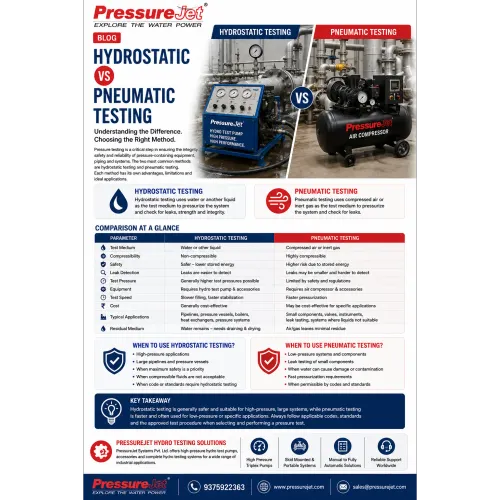
Hydrostatic testing uses water as the test medium and subjects the pipeline to a specified test pressure to identify leaks, weaknesses, defective joints, and other potential integrity problems.
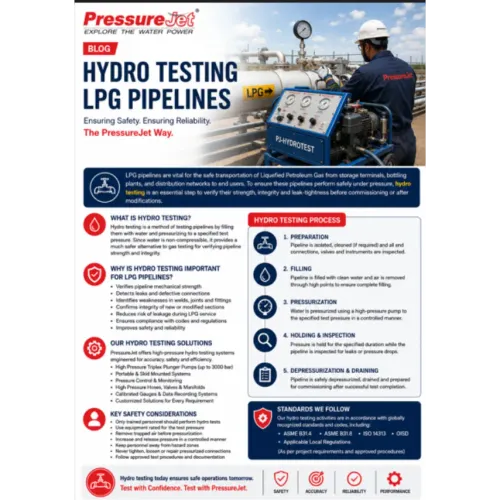
What Is Hydro Testing of an LPG Pipeline?
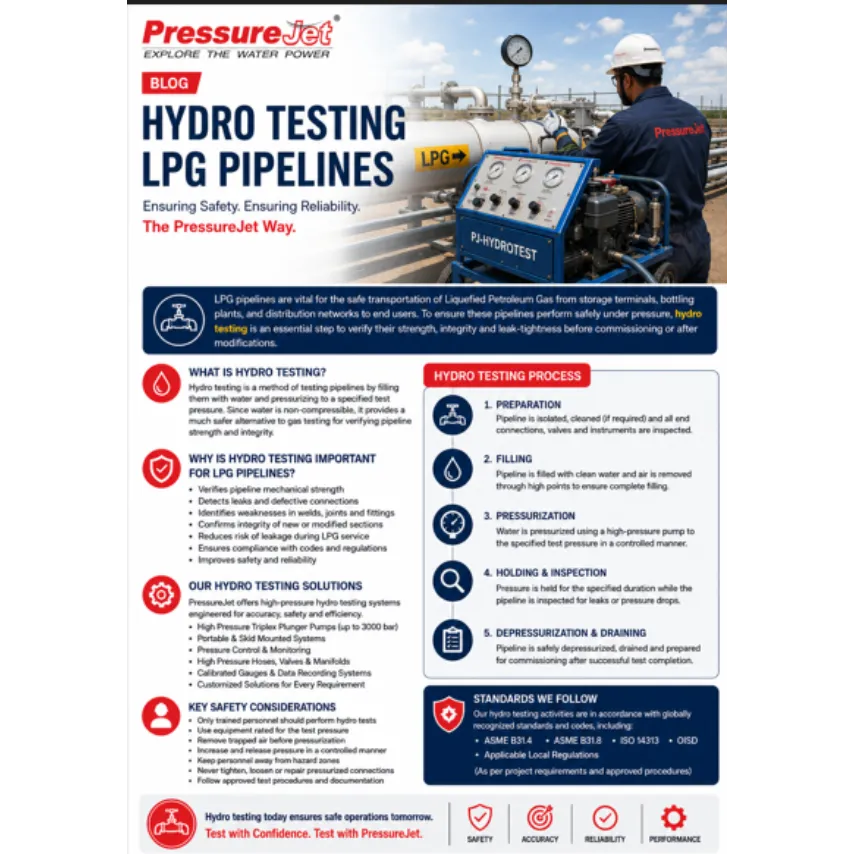
Hydro testing is a pressure test in which an LPG pipeline is filled with water and pressurized to a predetermined test pressure for a specified holding period.
Because water is substantially less compressible than gases, hydrostatic testing can provide a safer method of verifying pipeline integrity than testing with a compressible gas.
The test pressure, holding time, acceptance criteria, and test procedure must always be established according to the applicable design code, project specification, regulatory requirements, and approved engineering procedure.
Why Is Hydro Testing Important for LPG Pipelines?
Proper hydro testing helps to:
Verify pipeline mechanical strength.
Identify leaks and defective connections.
Detect weaknesses in welds, fittings, flanges, and joints.
Confirm the integrity of newly installed or modified sections.
Reduce the risk of leakage during subsequent LPG service.
Support compliance with applicable codes and statutory requirements.
Improve confidence before commissioning the pipeline.
For LPG applications, testing is particularly important because an undetected leak can create significant fire, explosion, environmental, and operational risks.
Hydro Testing Process for LPG Pipelines
1. Pipeline Preparation
The pipeline section is isolated from the operating system and prepared for testing. Valves, fittings, temporary connections, pressure gauges, vents, drains, and test equipment are checked.
Where applicable, the pipeline may be cleaned and inspected before filling.
2. Filling With Water
The isolated pipeline section is filled with suitable test water.
Air must be removed as effectively as possible through designated high-point vents because trapped air can affect test results and increase the stored energy of the test system.
3. Pressurization
A suitable high-pressure hydro testing pump is connected to the test section.
The pressure is increased in a controlled manner until the specified test pressure is reached. Pressure gauges and, where required, calibrated pressure recording equipment are used to monitor the test.
4. Pressure Holding & Inspection
The specified pressure is maintained for the required duration in accordance with the approved test procedure.
During this period, the pipeline and accessible components are inspected for:
Visible leakage
Pressure abnormalities
Joint or fitting problems
Abnormal deformation
Other indications of pipeline integrity issues
5. Depressurization & Draining
After successful completion and acceptance of the test, the pipeline is safely depressurized.
The test water is drained or removed using an approved procedure, and the pipeline is prepared for subsequent commissioning activities.
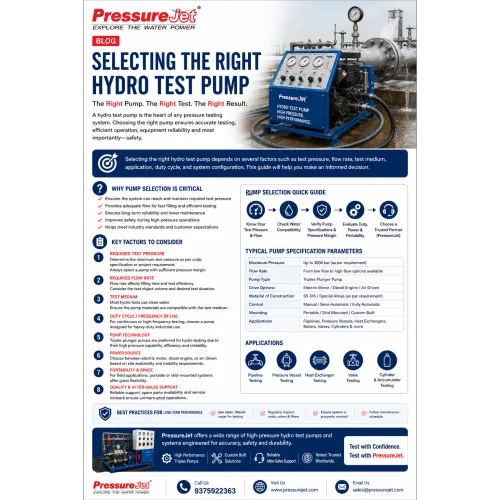
Selection of a Hydro Testing Pump
The hydro testing pump is a critical component of the test system. Selection should consider:
Test Pressure:
The pump must be capable of achieving the required test pressure with an appropriate engineering margin.
Flow Rate:
Adequate flow helps reduce filling and pressurization time, particularly for long or high-volume pipelines.
Pipeline Volume:
The water volume of the test section influences filling time, pump capacity, and overall testing duration.
Pressure Control:
Precise pressure control is important when approaching the specified test pressure.
Instrumentation:
Calibrated pressure gauges, pressure recorders, and suitable monitoring systems should be selected according to the test requirements.
Safety:
All hoses, fittings, manifolds, valves, and other pressure-containing components must be suitable for the intended test pressure.
PressureJet Hydro Testing Solutions
PressureJet Systems Pvt. Ltd. provides high-pressure pumping solutions for hydrostatic testing applications across industrial sectors.
Our hydro testing systems can be configured according to application requirements, including:
High-pressure triplex plunger pumps
High-pressure hydro testing units
Portable and skid-mounted systems
Pressure control and monitoring arrangements
High-pressure hoses and accessories
Test manifolds and valves
Pressure gauges and recording systems
Customized hydro testing packages
The appropriate pump pressure, flow rate, configuration, and accessories are selected based on the pipeline characteristics and approved test requirements.
Key Safety Considerations
Hydro testing involves high stored energy and should only be carried out by trained personnel using an approved test procedure.
Important considerations include:
Establish and barricade the test area.
Verify the test section and isolation points.
Ensure all pressure-containing equipment is rated for the intended pressure.
Use calibrated pressure instrumentation.
Remove trapped air as far as practicable.
Increase pressure in a controlled manner.
Keep personnel away from hazardous areas during pressurization.
Never tighten, loosen, or repair pressurized connections.
Follow the approved depressurization procedure.
Maintain proper test documentation and records.
Applicable Standards
The applicable hydro testing requirements depend on the pipeline type, service, design, jurisdiction, and project specification.
Commonly referenced standards and codes may include ASME B31.4, ASME B31.8, ISO 14313, OISD requirements, and applicable local regulations, where relevant to the particular LPG pipeline project.
The actual test pressure and procedure should not be selected solely from a general guideline; they should be established from the applicable design code, engineering documentation, regulatory requirements, and approved project procedure.
Conclusion
Hydro testing is a vital part of ensuring the strength, integrity, and leak-tightness of LPG pipelines before they are placed into service.
A correctly designed hydro testing system provides controlled pressurization, accurate monitoring, efficient testing, and improved safety during pipeline integrity verification.
With its expertise in high-pressure pumping technology, PressureJet offers hydro testing solutions designed for demanding industrial applications.
Test With Confidence. Test With PressureJet.
PressureJet Systems Pvt. Ltd.
High Pressure Pumps & Hydro Testing Systems
📞 +91 9375922363
✉️ sales@pressurejet.com
Hydro testing is one of the most important methods used to verify the strength and integrity of LPG pipelines before commissioning, after major modifications, or during maintenance and inspection activities.
Hydrostatic testing uses water as the test medium and subjects the pipeline to a specified test pressure to identify leaks, weaknesses, defective joints, and other potential integrity problems.
What Is Hydro Testing of an LPG Pipeline?
Hydro testing is a pressure test in which an LPG pipeline is filled with water and pressurized to a predetermined test pressure for a specified holding period.
Because water is substantially less compressible than gases, hydrostatic testing can provide a safer method of verifying pipeline integrity than testing with a compressible gas.
The test pressure, holding time, acceptance criteria, and test procedure must always be established according to the applicable design code, project specification, regulatory requirements, and approved engineering procedure.
Why Is Hydro Testing Important for LPG Pipelines?
Proper hydro testing helps to:
Verify pipeline mechanical strength.
Identify leaks and defective connections.
Detect weaknesses in welds, fittings, flanges, and joints.
Confirm the integrity of newly installed or modified sections.
Reduce the risk of leakage during subsequent LPG service.
Support compliance with applicable codes and statutory requirements.
Improve confidence before commissioning the pipeline.
For LPG applications, testing is particularly important because an undetected leak can create significant fire, explosion, environmental, and operational risks.
Hydro Testing Process for LPG Pipelines
1. Pipeline Preparation
The pipeline section is isolated from the operating system and prepared for testing. Valves, fittings, temporary connections, pressure gauges, vents, drains, and test equipment are checked.
Where applicable, the pipeline may be cleaned and inspected before filling.
2. Filling With Water
The isolated pipeline section is filled with suitable test water.
Air must be removed as effectively as possible through designated high-point vents because trapped air can affect test results and increase the stored energy of the test system.
3. Pressurization
A suitable high-pressure hydro testing pump is connected to the test section.
The pressure is increased in a controlled manner until the specified test pressure is reached. Pressure gauges and, where required, calibrated pressure recording equipment are used to monitor the test.
4. Pressure Holding & Inspection
The specified pressure is maintained for the required duration in accordance with the approved test procedure.
During this period, the pipeline and accessible components are inspected for:
Visible leakage
Pressure abnormalities
Joint or fitting problems
Abnormal deformation
Other indications of pipeline integrity issues
5. Depressurization & Draining
After successful completion and acceptance of the test, the pipeline is safely depressurized.
The test water is drained or removed using an approved procedure, and the pipeline is prepared for subsequent commissioning activities.
Selection of a Hydro Testing Pump
The hydro testing pump is a critical component of the test system. Selection should consider:
Test Pressure:
The pump must be capable of achieving the required test pressure with an appropriate engineering margin.
Flow Rate:
Adequate flow helps reduce filling and pressurization time, particularly for long or high-volume pipelines.
Pipeline Volume:
The water volume of the test section influences filling time, pump capacity, and overall testing duration.
Pressure Control:
Precise pressure control is important when approaching the specified test pressure.
Instrumentation:
Calibrated pressure gauges, pressure recorders, and suitable monitoring systems should be selected according to the test requirements.
Safety:
All hoses, fittings, manifolds, valves, and other pressure-containing components must be suitable for the intended test pressure.
PressureJet Hydro Testing Solutions
PressureJet Systems Pvt. Ltd. provides high-pressure pumping solutions for hydrostatic testing applications across industrial sectors.
Our hydro testing systems can be configured according to application requirements, including:
High-pressure triplex plunger pumps
High-pressure hydro testing units
Portable and skid-mounted systems
Pressure control and monitoring arrangements
High-pressure hoses and accessories
Test manifolds and valves
Pressure gauges and recording systems
Customized hydro testing packages
The appropriate pump pressure, flow rate, configuration, and accessories are selected based on the pipeline characteristics and approved test requirements.
Key Safety Considerations
Hydro testing involves high stored energy and should only be carried out by trained personnel using an approved test procedure.
Important considerations include:
Establish and barricade the test area.
Verify the test section and isolation points.
Ensure all pressure-containing equipment is rated for the intended pressure.
Use calibrated pressure instrumentation.
Remove trapped air as far as practicable.
Increase pressure in a controlled manner.
Keep personnel away from hazardous areas during pressurization.
Never tighten, loosen, or repair pressurized connections.
Follow the approved depressurization procedure.
Maintain proper test documentation and records.
Applicable Standards
The applicable hydro testing requirements depend on the pipeline type, service, design, jurisdiction, and project specification.
Commonly referenced standards and codes may include ASME B31.4, ASME B31.8, ISO 14313, OISD requirements, and applicable local regulations, where relevant to the particular LPG pipeline project.
The actual test pressure and procedure should not be selected solely from a general guideline; they should be established from the applicable design code, engineering documentation, regulatory requirements, and approved project procedure.
Conclusion
Hydro testing is a vital part of ensuring the strength, integrity, and leak-tightness of LPG pipelines before they are placed into service.
A correctly designed hydro testing system provides controlled pressurization, accurate monitoring, efficient testing, and improved safety during pipeline integrity verification.
With its expertise in high-pressure pumping technology, PressureJet offers hydro testing solutions designed for demanding industrial applications.
Test With Confidence. Test With PressureJet.
PressureJet Systems Pvt. Ltd.
High Pressure Pumps & Hydro Testing Systems
📞 +91 9375922363
✉️ sales@pressurejet.com
Keywords