Pressure testing is a critical step in verifying the integrity, strength, and leak-tightness of pressure-containing equipment and piping systems.
Two commonly used pressure-testing methods are:
Hydrostatic Testing — using water or another suitable liquid.
Pneumatic Testing — using compressed air or another suitable gas.
Although both methods are used to identify leaks and verify pressure integrity, they are fundamentally different in terms of test medium, stored energy, safety, equipment, testing speed, and application suitability.
Choosing between hydrostatic and pneumatic testing should always be based on the applicable design code, project specification, equipment limitations, and approved test procedure.
What Is Hydrostatic Testing?
Hydrostatic testing involves filling the test component with water or another suitable liquid and pressurizing it to the specified test pressure.
Because liquids are relatively incompressible, hydrostatic testing generally stores much less energy than a comparable pneumatic test at the same pressure.
This is one of the key reasons hydrostatic testing is commonly preferred where practical. ASME materials specifically address both hydrostatic and pneumatic pressure-test requirements for pressure vessels, while pipeline standards also address both methods.
Typical Hydrostatic Testing Equipment
A hydrostatic test system may include:
High-pressure triplex plunger pump
Low-pressure filling pump
Pressure gauges
Pressure transmitters
Test manifold
High-pressure hoses
Isolation valves
Pressure recorder/data logger
Safety relief arrangements
What Is Pneumatic Testing?
Pneumatic testing uses compressed air, nitrogen, or another suitable gas as the test medium.
Because gases are highly compressible, a pneumatic test can store substantially more energy than a hydrostatic test. Consequently, pneumatic testing requires particularly careful engineering controls, exclusion zones, procedures, and personnel protection.
In some codes and applications, pneumatic testing is permitted when hydrostatic testing is impractical because of factors such as water contamination, freezing, difficulty draining/drying, or limitations associated with the equipment. ASME-related guidance recognizes pneumatic testing as a distinct pressure-testing method, with specific requirements and precautions.
Hydrostatic vs Pneumatic Testing: Comparison
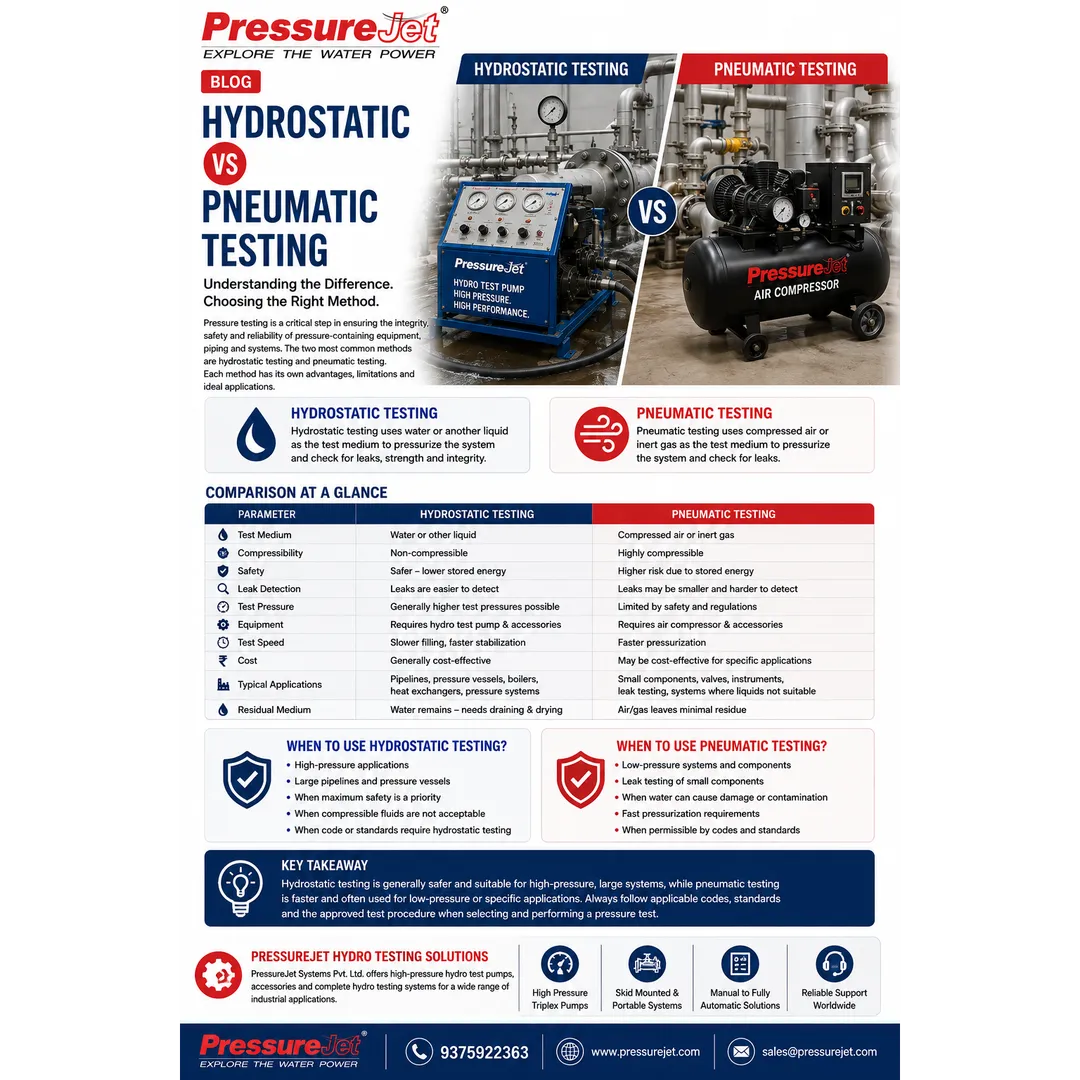
Parameter Hydrostatic Testing Pneumatic Testing
Test Medium Water or suitable liquid Compressed air, nitrogen or suitable gas
Compressibility Very low High
Stored Energy Generally lower Significantly higher
Safety Generally safer when properly conducted Requires additional precautions
Leak Detection Generally straightforward Can be more difficult depending on application
Test Speed Filling can take time Pressurization can be relatively fast
Drying Requirement Usually requires draining/drying Minimal liquid residue
High-Pressure Applications Widely used where permitted More restricted depending on code/application
Typical Equipment Hydro test pump Compressor/gas source and pressure-control equipment
Typical Applications Pipelines, vessels, heat exchangers, piping Leak tests, selected systems/components
Main Consideration Water handling and drying Stored energy and safety
1. Safety: The Biggest Difference
Safety is one of the most important differences between the two methods.
Water is essentially incompressible compared with air or other gases. Therefore, a pressurized water-filled system generally contains considerably less stored energy than a gas-filled system at comparable conditions.
Pneumatic testing can therefore present a significantly greater hazard if a component, fitting, closure, or connection fails.
OSHA guidance provides an example of this principle in hydrostatic testing of fire-extinguisher equipment and specifically warns against using air or gas for hydrostatic testing because compressed gas can expand significantly.
Key point: Pneumatic testing should never be treated simply as a faster alternative to hydrostatic testing.
2. Test Medium
Hydrostatic
Water is the most common test medium.
Advantages include:
Low compressibility
Easy availability
Effective pressure transmission
Relatively low stored energy
However, the water must subsequently be drained, and some applications may require drying.
Pneumatic
Pneumatic testing uses gases such as:
Compressed air
Nitrogen
Other approved gases
The choice of gas depends on the application, contamination requirements, safety requirements, and approved procedure.
3. Testing Speed
Pneumatic testing can achieve pressure relatively quickly because gas does not require filling and draining the same way as a liquid-filled system.
However, faster pressurization does not automatically mean faster overall testing.
A proper pressure test also involves:
Stabilization
Pressure holding
Inspection
Leak evaluation
Controlled depressurization
Documentation
Therefore, the complete test cycle should be considered when comparing methods.
4. Leak Detection
Both methods can identify leaks, but the inspection approach can differ.
During hydrostatic testing, visible water leakage can often be readily identified around accessible joints, fittings, welds, and connections.
During pneumatic testing, gas leakage may require specialized leak-detection methods, depending on the application and test procedure.
For critical systems, the selected leak-detection method should be specified in the approved procedure.
5. Water Contamination & Drying
One of the limitations of hydrostatic testing is that the test object must subsequently be drained.
Some applications are highly sensitive to residual moisture, including certain:
Gas systems
Instrumentation systems
Cryogenic systems
Process equipment
Corrosion-sensitive equipment
In such cases, drying may become an important part of the post-test procedure.
Where the applicable code permits it, pneumatic testing may be considered when introducing water is impractical.
6. Where Is Hydrostatic Testing Preferred?
Hydrostatic testing is generally attractive for applications where water can be safely introduced and removed.
Typical applications include:
Pipelines
Hydrostatic testing is widely used for pipeline integrity testing where permitted by the applicable standard.
Pressure Vessels
Pressure vessels are commonly hydrostatically tested according to their governing design and inspection requirements.
Heat Exchangers
Hydrostatic testing can be used to verify pressure integrity of heat exchanger components.
Boilers & Process Piping
Water-based pressure testing is commonly used where permitted by the applicable code and plant procedure.
ASME's pressure-vessel guidance explicitly covers both hydrostatic and pneumatic pressure testing requirements.
7. When Can Pneumatic Testing Be Considered?
Pneumatic testing may be considered where hydrostatic testing is impractical or undesirable and where the applicable code permits it.
Examples can include situations where:
Water could contaminate the system.
Complete drying is difficult.
Water could freeze.
The equipment cannot safely support the weight of water.
The internal geometry makes draining difficult.
Project or service requirements specifically call for pneumatic testing.
However, the decision must be made through the applicable engineering and safety procedure.
For example, ASME-related requirements distinguish hydrostatic and pneumatic testing, while some pressure-system standards allow pneumatic testing under defined conditions when hydrostatic testing is not practicable.
Hydrostatic Testing: Advantages & Limitations
Advantages
✔ Generally lower stored energy
✔ Suitable for many high-pressure applications
✔ Effective for strength and leak testing
✔ Water is widely available
✔ High-pressure hydro test pumps are well established
✔ Suitable for large pipelines and pressure vessels
Limitations
✘ Requires filling with water
✘ Water must be drained after testing
✘ Some applications require drying
✘ Water quality may need to be controlled
✘ Filling large-volume systems can take time
Pneumatic Testing: Advantages & Limitations
Advantages
✔ No liquid water remains in the test system
✔ Useful where water introduction is impractical
✔ Can be useful for selected leak-testing applications
✔ Can provide rapid pressurization
Limitations
✘ Significantly higher stored energy
✘ Greater consequences if a component fails
✘ Requires stringent safety precautions
✘ May require larger exclusion zones
✘ Not permitted as a substitute for hydrostatic testing in every application
OSHA's hazardous-energy guidance emphasizes the importance of isolating and safely releasing stored energy before work is performed on pressurized systems.
Which Testing Method Should You Choose?
There is no universal answer.
The correct method depends on:
Applicable design code
Equipment design
Test pressure
Test medium compatibility
Water availability
Drainage and drying requirements
Environmental conditions
Equipment weight limitations
Consequences of failure
Project specifications
Regulatory requirements
Approved test procedure
A Simple Decision Approach
Can the equipment safely be filled with water?
→ Yes: Hydrostatic testing is often the preferred option where permitted.
→ No: Determine whether pneumatic testing is permitted by the applicable code and whether the necessary safety controls can be implemented.
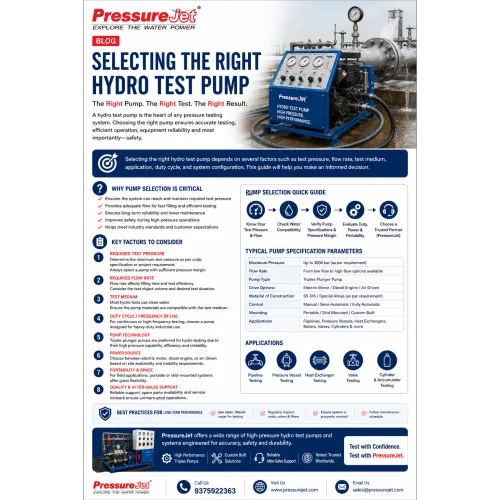
Hydro Test Pump Selection for Hydrostatic Testing
When hydrostatic testing is selected, the hydro test pump becomes a critical part of the system.
Pump selection should consider:
Required test pressure
Required flow rate
Test volume
Duty cycle
Power source
Portability
Pressure control
Instrumentation
Automation requirements
For industrial high-pressure testing, triplex plunger pumps are commonly used because they can provide high pressure and reliable operation.
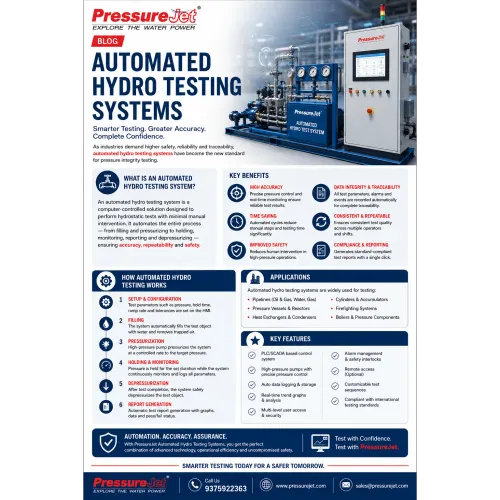
For repetitive production testing, automated hydro testing systems can additionally provide:
PLC/HMI control
Automatic pressure regulation
Data logging
Pressure-versus-time graphs
Programmable test sequences
Automatic report generation
Alarm and safety interlocks
PressureJet Hydro Testing Solutions
PressureJet Systems Pvt. Ltd. provides high-pressure hydro test pumps and complete hydro testing systems for industrial applications.
Our solutions can be configured for:
Pipeline hydro testing
Pressure vessel testing
Heat exchanger testing
Valve testing
Cylinder testing
Boiler testing
Industrial equipment testing
Automated production testing
Available configurations can include:
High-Pressure Triplex Plunger Pumps | Portable Systems | Skid-Mounted Systems | Automated Hydro Testing Systems | Pressure Control | Data Recording | Test Manifolds & Accessories
The system configuration should always be selected according to the actual test pressure, flow, test object, applicable standards, and approved test procedure.
Final Takeaway
Hydrostatic and pneumatic testing are not interchangeable by default.
Hydrostatic testing generally offers a lower stored-energy risk because it uses a liquid, making it a preferred method for many pressure-testing applications where water can be used.
Pneumatic testing can be appropriate for selected applications where hydrostatic testing is impractical and the governing code permits it—but the increased stored-energy hazard demands rigorous engineering controls and safety procedures.
The right testing method is therefore determined by a combination of engineering requirements, applicable standards, equipment limitations, safety considerations, and project requirements.
Test With Confidence. Test With PressureJet.
PressureJet Systems Pvt. Ltd.
High Pressure Pumps & Hydro Testing Systems
📞 9375922363
🌐 www.pressurejet.com
✉️ sales@pressurejet.com
Two commonly used pressure-testing methods are:
Hydrostatic Testing — using water or another suitable liquid.
Pneumatic Testing — using compressed air or another suitable gas.
Although both methods are used to identify leaks and verify pressure integrity, they are fundamentally different in terms of test medium, stored energy, safety, equipment, testing speed, and application suitability.
Choosing between hydrostatic and pneumatic testing should always be based on the applicable design code, project specification, equipment limitations, and approved test procedure.
What Is Hydrostatic Testing?
Hydrostatic testing involves filling the test component with water or another suitable liquid and pressurizing it to the specified test pressure.
Because liquids are relatively incompressible, hydrostatic testing generally stores much less energy than a comparable pneumatic test at the same pressure.
This is one of the key reasons hydrostatic testing is commonly preferred where practical. ASME materials specifically address both hydrostatic and pneumatic pressure-test requirements for pressure vessels, while pipeline standards also address both methods.
Typical Hydrostatic Testing Equipment
A hydrostatic test system may include:
High-pressure triplex plunger pump
Low-pressure filling pump
Pressure gauges
Pressure transmitters
Test manifold
High-pressure hoses
Isolation valves
Pressure recorder/data logger
Safety relief arrangements
What Is Pneumatic Testing?
Pneumatic testing uses compressed air, nitrogen, or another suitable gas as the test medium.
Because gases are highly compressible, a pneumatic test can store substantially more energy than a hydrostatic test. Consequently, pneumatic testing requires particularly careful engineering controls, exclusion zones, procedures, and personnel protection.
In some codes and applications, pneumatic testing is permitted when hydrostatic testing is impractical because of factors such as water contamination, freezing, difficulty draining/drying, or limitations associated with the equipment. ASME-related guidance recognizes pneumatic testing as a distinct pressure-testing method, with specific requirements and precautions.
Hydrostatic vs Pneumatic Testing: Comparison
Parameter Hydrostatic Testing Pneumatic Testing
Test Medium Water or suitable liquid Compressed air, nitrogen or suitable gas
Compressibility Very low High
Stored Energy Generally lower Significantly higher
Safety Generally safer when properly conducted Requires additional precautions
Leak Detection Generally straightforward Can be more difficult depending on application
Test Speed Filling can take time Pressurization can be relatively fast
Drying Requirement Usually requires draining/drying Minimal liquid residue
High-Pressure Applications Widely used where permitted More restricted depending on code/application
Typical Equipment Hydro test pump Compressor/gas source and pressure-control equipment
Typical Applications Pipelines, vessels, heat exchangers, piping Leak tests, selected systems/components
Main Consideration Water handling and drying Stored energy and safety
1. Safety: The Biggest Difference
Safety is one of the most important differences between the two methods.
Water is essentially incompressible compared with air or other gases. Therefore, a pressurized water-filled system generally contains considerably less stored energy than a gas-filled system at comparable conditions.
Pneumatic testing can therefore present a significantly greater hazard if a component, fitting, closure, or connection fails.
OSHA guidance provides an example of this principle in hydrostatic testing of fire-extinguisher equipment and specifically warns against using air or gas for hydrostatic testing because compressed gas can expand significantly.
Key point: Pneumatic testing should never be treated simply as a faster alternative to hydrostatic testing.
2. Test Medium
Hydrostatic
Water is the most common test medium.
Advantages include:
Low compressibility
Easy availability
Effective pressure transmission
Relatively low stored energy
However, the water must subsequently be drained, and some applications may require drying.
Pneumatic
Pneumatic testing uses gases such as:
Compressed air
Nitrogen
Other approved gases
The choice of gas depends on the application, contamination requirements, safety requirements, and approved procedure.
3. Testing Speed
Pneumatic testing can achieve pressure relatively quickly because gas does not require filling and draining the same way as a liquid-filled system.
However, faster pressurization does not automatically mean faster overall testing.
A proper pressure test also involves:
Stabilization
Pressure holding
Inspection
Leak evaluation
Controlled depressurization
Documentation
Therefore, the complete test cycle should be considered when comparing methods.
4. Leak Detection
Both methods can identify leaks, but the inspection approach can differ.
During hydrostatic testing, visible water leakage can often be readily identified around accessible joints, fittings, welds, and connections.
During pneumatic testing, gas leakage may require specialized leak-detection methods, depending on the application and test procedure.
For critical systems, the selected leak-detection method should be specified in the approved procedure.
5. Water Contamination & Drying
One of the limitations of hydrostatic testing is that the test object must subsequently be drained.
Some applications are highly sensitive to residual moisture, including certain:
Gas systems
Instrumentation systems
Cryogenic systems
Process equipment
Corrosion-sensitive equipment
In such cases, drying may become an important part of the post-test procedure.
Where the applicable code permits it, pneumatic testing may be considered when introducing water is impractical.
6. Where Is Hydrostatic Testing Preferred?
Hydrostatic testing is generally attractive for applications where water can be safely introduced and removed.
Typical applications include:
Pipelines
Hydrostatic testing is widely used for pipeline integrity testing where permitted by the applicable standard.
Pressure Vessels
Pressure vessels are commonly hydrostatically tested according to their governing design and inspection requirements.
Heat Exchangers
Hydrostatic testing can be used to verify pressure integrity of heat exchanger components.
Boilers & Process Piping
Water-based pressure testing is commonly used where permitted by the applicable code and plant procedure.
ASME's pressure-vessel guidance explicitly covers both hydrostatic and pneumatic pressure testing requirements.
7. When Can Pneumatic Testing Be Considered?
Pneumatic testing may be considered where hydrostatic testing is impractical or undesirable and where the applicable code permits it.
Examples can include situations where:
Water could contaminate the system.
Complete drying is difficult.
Water could freeze.
The equipment cannot safely support the weight of water.
The internal geometry makes draining difficult.
Project or service requirements specifically call for pneumatic testing.
However, the decision must be made through the applicable engineering and safety procedure.
For example, ASME-related requirements distinguish hydrostatic and pneumatic testing, while some pressure-system standards allow pneumatic testing under defined conditions when hydrostatic testing is not practicable.
Hydrostatic Testing: Advantages & Limitations
Advantages
✔ Generally lower stored energy
✔ Suitable for many high-pressure applications
✔ Effective for strength and leak testing
✔ Water is widely available
✔ High-pressure hydro test pumps are well established
✔ Suitable for large pipelines and pressure vessels
Limitations
✘ Requires filling with water
✘ Water must be drained after testing
✘ Some applications require drying
✘ Water quality may need to be controlled
✘ Filling large-volume systems can take time
Pneumatic Testing: Advantages & Limitations
Advantages
✔ No liquid water remains in the test system
✔ Useful where water introduction is impractical
✔ Can be useful for selected leak-testing applications
✔ Can provide rapid pressurization
Limitations
✘ Significantly higher stored energy
✘ Greater consequences if a component fails
✘ Requires stringent safety precautions
✘ May require larger exclusion zones
✘ Not permitted as a substitute for hydrostatic testing in every application
OSHA's hazardous-energy guidance emphasizes the importance of isolating and safely releasing stored energy before work is performed on pressurized systems.
Which Testing Method Should You Choose?
There is no universal answer.
The correct method depends on:
Applicable design code
Equipment design
Test pressure
Test medium compatibility
Water availability
Drainage and drying requirements
Environmental conditions
Equipment weight limitations
Consequences of failure
Project specifications
Regulatory requirements
Approved test procedure
A Simple Decision Approach
Can the equipment safely be filled with water?
→ Yes: Hydrostatic testing is often the preferred option where permitted.
→ No: Determine whether pneumatic testing is permitted by the applicable code and whether the necessary safety controls can be implemented.
Hydro Test Pump Selection for Hydrostatic Testing
When hydrostatic testing is selected, the hydro test pump becomes a critical part of the system.
Pump selection should consider:
Required test pressure
Required flow rate
Test volume
Duty cycle
Power source
Portability
Pressure control
Instrumentation
Automation requirements
For industrial high-pressure testing, triplex plunger pumps are commonly used because they can provide high pressure and reliable operation.
For repetitive production testing, automated hydro testing systems can additionally provide:
PLC/HMI control
Automatic pressure regulation
Data logging
Pressure-versus-time graphs
Programmable test sequences
Automatic report generation
Alarm and safety interlocks
PressureJet Hydro Testing Solutions
PressureJet Systems Pvt. Ltd. provides high-pressure hydro test pumps and complete hydro testing systems for industrial applications.
Our solutions can be configured for:
Pipeline hydro testing
Pressure vessel testing
Heat exchanger testing
Valve testing
Cylinder testing
Boiler testing
Industrial equipment testing
Automated production testing
Available configurations can include:
High-Pressure Triplex Plunger Pumps | Portable Systems | Skid-Mounted Systems | Automated Hydro Testing Systems | Pressure Control | Data Recording | Test Manifolds & Accessories
The system configuration should always be selected according to the actual test pressure, flow, test object, applicable standards, and approved test procedure.
Final Takeaway
Hydrostatic and pneumatic testing are not interchangeable by default.
Hydrostatic testing generally offers a lower stored-energy risk because it uses a liquid, making it a preferred method for many pressure-testing applications where water can be used.
Pneumatic testing can be appropriate for selected applications where hydrostatic testing is impractical and the governing code permits it—but the increased stored-energy hazard demands rigorous engineering controls and safety procedures.
The right testing method is therefore determined by a combination of engineering requirements, applicable standards, equipment limitations, safety considerations, and project requirements.
Test With Confidence. Test With PressureJet.
PressureJet Systems Pvt. Ltd.
High Pressure Pumps & Hydro Testing Systems
📞 9375922363
🌐 www.pressurejet.com
✉️ sales@pressurejet.com
Keywords