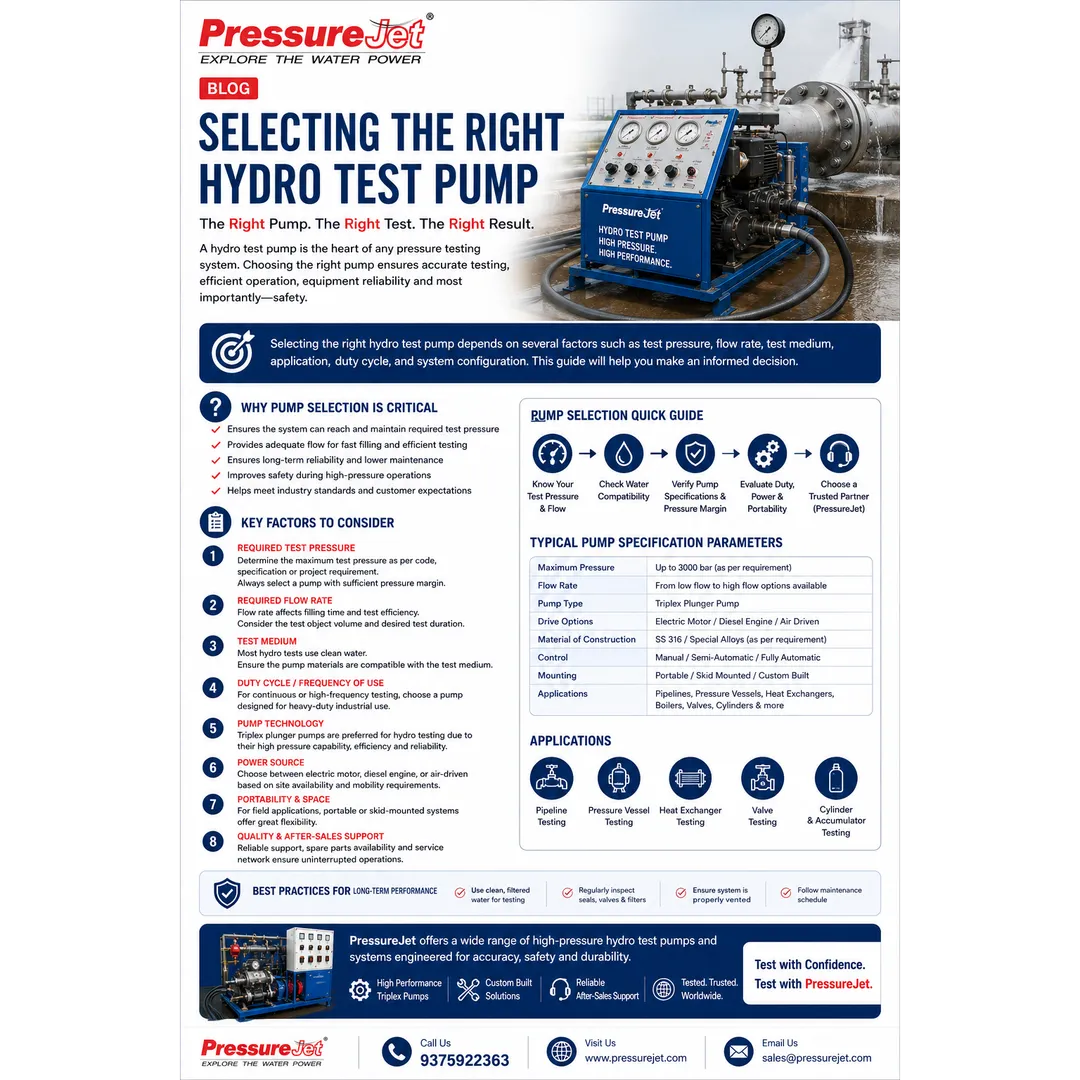
A hydro test pump is the heart of any hydrostatic pressure testing system. The pump must deliver the required pressure and flow reliably while allowing the operator to perform the test safely and accurately.
Choosing a pump simply based on its maximum pressure rating is not enough. The correct selection depends on several factors, including required test pressure, flow rate, test volume, test medium, duty cycle, power source, portability, automation, and application.
Selecting the right pump can help reduce testing time, improve reliability, minimize operating costs, and deliver more consistent test results.
What Is a Hydro Test Pump?
A hydro test pump is a high-pressure pump used to pressurize equipment or piping with a liquid—typically water—for hydrostatic pressure testing.
Hydro test pumps are commonly used for:
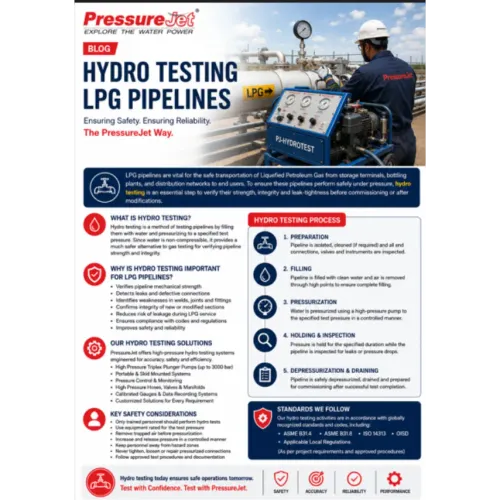
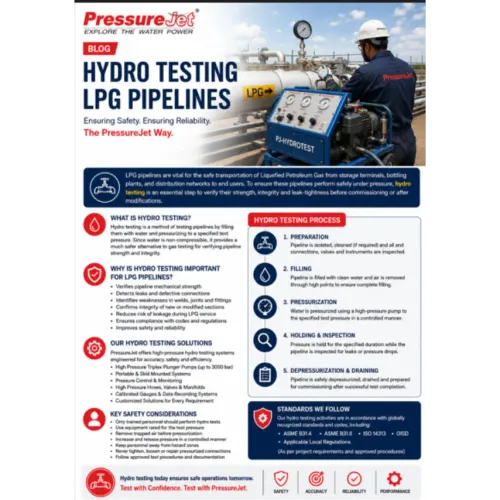
Pipelines
Pressure vessels
Heat exchangers
Boilers
Valves
Cylinders
Accumulators
Process piping
Firefighting systems
Industrial equipment
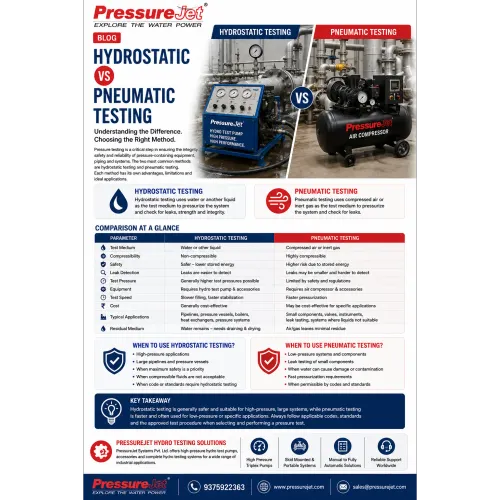
For high-pressure industrial applications, triplex plunger pumps are widely used because they can provide high pressure with reliable and controlled operation.
Why Is Correct Pump Selection Important?
Selecting an undersized or incorrectly configured pump can result in:
Excessive testing time
Difficulty reaching the required pressure
Poor pressure stability
Increased wear and maintenance
Higher operating costs
Safety risks
Inconsistent test results
On the other hand, a correctly selected hydro test pump provides:
Right Pressure + Right Flow + Reliable Operation = Efficient Hydro Testing
8 Key Factors for Selecting a Hydro Test Pump
1. Required Test Pressure
The first and most important parameter is the required hydro test pressure.
Determine the maximum test pressure from the applicable:
Design code
Equipment specification
Project specification
Manufacturer's requirements
Approved hydro test procedure
The selected pump should be capable of achieving the specified pressure with an appropriate engineering margin.
Important:
Do not select a pump solely because its nameplate pressure is higher than the required pressure. The complete system—including hoses, valves, manifolds, fittings, gauges, and connections—must be suitable for the intended pressure.
2. Required Flow Rate
Pressure alone does not determine testing efficiency.
Flow rate directly affects how quickly the test object can be filled and pressurized.
For example, a large pipeline or pressure vessel may require significantly more water than a small valve or cylinder.
A suitable flow rate can reduce:
Filling time
Pressurization time
Overall test cycle time
However, extremely high flow is not always necessary during the final pressure build-up. The ideal pump configuration depends on the test volume and required test sequence.
3. Test Volume
The volume of the equipment being tested is an important factor.
A large pipeline may contain thousands of litres of water, whereas a small valve may require only a few litres.
Before selecting the pump, estimate:
Test Volume → Filling Time → Required Flow → Pump Selection
For large-volume applications, a separate low-pressure filling arrangement may be used along with a high-pressure pump to optimize the overall test cycle.
4. Test Medium
Hydrostatic testing generally uses water, but the quality and characteristics of the test medium should be considered.
Depending on the application, test water may need to be:
Clean
Filtered
Free from harmful contaminants
Compatible with the test equipment
Treated where required by the application
Pump wetted materials should also be compatible with the test medium and operating conditions.
5. Duty Cycle & Frequency of Testing
Consider how frequently the pump will be operated.
There is a major difference between:
Occasional Testing
and
Continuous Production Testing
If a manufacturing facility performs hundreds of tests every month, the pump should be selected for the expected duty cycle and operating environment.
For demanding industrial applications, a robust triplex plunger pump can provide reliable high-pressure performance over repeated testing cycles.
6. Power Source
The available power source is another important selection parameter.
Hydro test pumps can be configured with different drive arrangements, depending on the application.
Electric Motor
Suitable for:
Manufacturing plants
Workshops
Industrial facilities
Fixed testing stations
Diesel Engine
Useful for:
Remote locations
Pipeline projects
Outdoor testing
Locations without reliable electrical power
Other Drive Options
Special applications may require alternative drive configurations according to site conditions and customer requirements.
7. Portability & Installation
Consider where the hydro test pump will be used.
Portable Systems
Suitable for:
Field testing
Pipeline construction
Maintenance work
Multiple testing locations
Skid-Mounted Systems
Suitable for:
Industrial plants
Production facilities
Dedicated testing stations
Customized Systems
For high-volume or specialized applications, the pump can be integrated with:
Control panels
Pressure instrumentation
Test manifolds
Valves
Data acquisition systems
Automatic pressure control
8. Automation & Data Recording
Modern hydro testing increasingly requires accurate digital records.
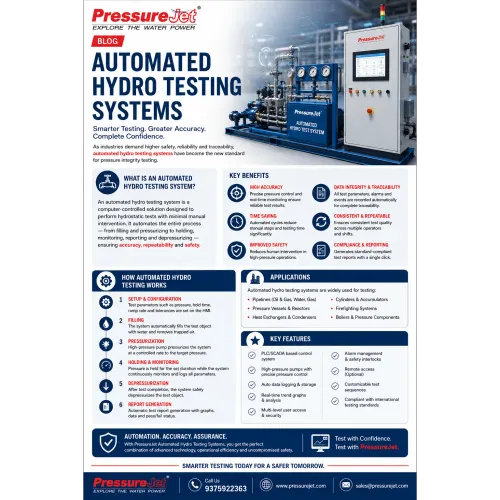
If testing is performed frequently, consider an automated hydro testing system with:
PLC/HMI control
Automatic pressure control
Pressure transmitters
Data logging
Pressure-versus-time graphs
Programmable test sequences
Alarm management
Automatic test reports
Pass/fail evaluation
Automation can improve repeatability, traceability, safety, and productivity.
Triplex Plunger Pump: Why Is It Preferred for Hydro Testing?
Triplex plunger pumps are commonly selected for high-pressure hydro testing because of their:
High-pressure capability
Robust construction
Good efficiency
Reliable continuous operation
Compact design
Availability across a wide range of pressure and flow combinations
The correct pump should nevertheless be selected based on the complete application—not merely the pump type.
Quick Hydro Test Pump Selection Guide
Parameter What to Determine
Test Pressure Maximum pressure required by the approved procedure
Flow Rate Required filling and pressurization speed
Test Volume Volume of pipeline/equipment
Test Medium Water quality and compatibility
Duty Cycle Occasional or continuous testing
Power Electric, diesel, or other drive
Installation Portable, skid-mounted, or fixed
Automation Manual, semi-automatic, or fully automatic
Instrumentation Gauges, transmitters, recorders
Safety Relief, isolation and pressure-rated components
Service Spare parts and after-sales support
Common Applications
The right hydro test pump can be configured for a wide range of applications.
Pipeline Testing
Testing oil, gas, water, LPG and industrial pipelines.
Pressure Vessel Testing
Hydrostatic testing of pressure vessels, reactors and storage equipment.
Heat Exchanger Testing
Testing shell-and-tube heat exchangers, condensers and associated components.
Valve Testing
Hydro testing of industrial valves and pressure-containing components.
Cylinder & Accumulator Testing
Testing hydraulic cylinders, gas cylinders and accumulators according to the applicable procedure.
Boiler & Power Plant Applications
Testing pressure-containing components and piping systems.
Best Practices for Long-Term Pump Performance
After selecting the right pump, proper operation and maintenance are equally important.
Use Suitable Test Water
Use clean and appropriately filtered water according to the application requirements.
Prevent Air Entrapment
Proper venting helps improve test reliability and reduces risks associated with trapped air.
Monitor Pressure
Use properly selected and calibrated pressure instrumentation.
Inspect High-Pressure Components
Regularly inspect hoses, valves, seals, fittings, manifolds and connections.
Follow the Maintenance Schedule
Regular maintenance helps extend pump life and minimize unexpected downtime.
Use Trained Operators
High-pressure hydro testing should always be performed by trained personnel following an approved procedure.
PressureJet Hydro Test Pumps & Systems
PressureJet Systems Pvt. Ltd. provides high-pressure hydro test pumps and complete hydro testing systems for industrial applications.
Our solutions can be configured according to the required:
Pressure
Flow rate
Test volume
Duty cycle
Power source
Portability
Automation level
Instrumentation
Application requirements
Solutions can include high-pressure triplex plunger pumps, portable hydro test units, skid-mounted systems, automated hydro testing systems, pressure control systems, test manifolds, high-pressure hoses, valves and instrumentation.
The Right Pump Makes the Difference
Selecting the right hydro test pump is not simply about choosing the highest-pressure model.
The best solution is the one that provides the required pressure, appropriate flow, reliable operation, safe control, suitable configuration, and long-term serviceability for the specific application.
A properly selected hydro test pump can help you achieve:
Faster Testing • Better Control • Higher Reliability • Improved Safety • Consistent Results
Test With Confidence. Test With PressureJet.
PressureJet Systems Pvt. Ltd.
High Pressure Pumps & Hydro Testing Systems
📞 9375922363
🌐 www.pressurejet.com
✉️ sales@pressurejet.com
Choosing a pump simply based on its maximum pressure rating is not enough. The correct selection depends on several factors, including required test pressure, flow rate, test volume, test medium, duty cycle, power source, portability, automation, and application.
Selecting the right pump can help reduce testing time, improve reliability, minimize operating costs, and deliver more consistent test results.
What Is a Hydro Test Pump?
A hydro test pump is a high-pressure pump used to pressurize equipment or piping with a liquid—typically water—for hydrostatic pressure testing.
Hydro test pumps are commonly used for:
Pipelines
Pressure vessels
Heat exchangers
Boilers
Valves
Cylinders
Accumulators
Process piping
Firefighting systems
Industrial equipment
For high-pressure industrial applications, triplex plunger pumps are widely used because they can provide high pressure with reliable and controlled operation.
Why Is Correct Pump Selection Important?
Selecting an undersized or incorrectly configured pump can result in:
Excessive testing time
Difficulty reaching the required pressure
Poor pressure stability
Increased wear and maintenance
Higher operating costs
Safety risks
Inconsistent test results
On the other hand, a correctly selected hydro test pump provides:
Right Pressure + Right Flow + Reliable Operation = Efficient Hydro Testing
8 Key Factors for Selecting a Hydro Test Pump
1. Required Test Pressure
The first and most important parameter is the required hydro test pressure.
Determine the maximum test pressure from the applicable:
Design code
Equipment specification
Project specification
Manufacturer's requirements
Approved hydro test procedure
The selected pump should be capable of achieving the specified pressure with an appropriate engineering margin.
Important:
Do not select a pump solely because its nameplate pressure is higher than the required pressure. The complete system—including hoses, valves, manifolds, fittings, gauges, and connections—must be suitable for the intended pressure.
2. Required Flow Rate
Pressure alone does not determine testing efficiency.
Flow rate directly affects how quickly the test object can be filled and pressurized.
For example, a large pipeline or pressure vessel may require significantly more water than a small valve or cylinder.
A suitable flow rate can reduce:
Filling time
Pressurization time
Overall test cycle time
However, extremely high flow is not always necessary during the final pressure build-up. The ideal pump configuration depends on the test volume and required test sequence.
3. Test Volume
The volume of the equipment being tested is an important factor.
A large pipeline may contain thousands of litres of water, whereas a small valve may require only a few litres.
Before selecting the pump, estimate:
Test Volume → Filling Time → Required Flow → Pump Selection
For large-volume applications, a separate low-pressure filling arrangement may be used along with a high-pressure pump to optimize the overall test cycle.
4. Test Medium
Hydrostatic testing generally uses water, but the quality and characteristics of the test medium should be considered.
Depending on the application, test water may need to be:
Clean
Filtered
Free from harmful contaminants
Compatible with the test equipment
Treated where required by the application
Pump wetted materials should also be compatible with the test medium and operating conditions.
5. Duty Cycle & Frequency of Testing
Consider how frequently the pump will be operated.
There is a major difference between:
Occasional Testing
and
Continuous Production Testing
If a manufacturing facility performs hundreds of tests every month, the pump should be selected for the expected duty cycle and operating environment.
For demanding industrial applications, a robust triplex plunger pump can provide reliable high-pressure performance over repeated testing cycles.
6. Power Source
The available power source is another important selection parameter.
Hydro test pumps can be configured with different drive arrangements, depending on the application.
Electric Motor
Suitable for:
Manufacturing plants
Workshops
Industrial facilities
Fixed testing stations
Diesel Engine
Useful for:
Remote locations
Pipeline projects
Outdoor testing
Locations without reliable electrical power
Other Drive Options
Special applications may require alternative drive configurations according to site conditions and customer requirements.
7. Portability & Installation
Consider where the hydro test pump will be used.
Portable Systems
Suitable for:
Field testing
Pipeline construction
Maintenance work
Multiple testing locations
Skid-Mounted Systems
Suitable for:
Industrial plants
Production facilities
Dedicated testing stations
Customized Systems
For high-volume or specialized applications, the pump can be integrated with:
Control panels
Pressure instrumentation
Test manifolds
Valves
Data acquisition systems
Automatic pressure control
8. Automation & Data Recording
Modern hydro testing increasingly requires accurate digital records.
If testing is performed frequently, consider an automated hydro testing system with:
PLC/HMI control
Automatic pressure control
Pressure transmitters
Data logging
Pressure-versus-time graphs
Programmable test sequences
Alarm management
Automatic test reports
Pass/fail evaluation
Automation can improve repeatability, traceability, safety, and productivity.
Triplex Plunger Pump: Why Is It Preferred for Hydro Testing?
Triplex plunger pumps are commonly selected for high-pressure hydro testing because of their:
High-pressure capability
Robust construction
Good efficiency
Reliable continuous operation
Compact design
Availability across a wide range of pressure and flow combinations
The correct pump should nevertheless be selected based on the complete application—not merely the pump type.
Quick Hydro Test Pump Selection Guide
Parameter What to Determine
Test Pressure Maximum pressure required by the approved procedure
Flow Rate Required filling and pressurization speed
Test Volume Volume of pipeline/equipment
Test Medium Water quality and compatibility
Duty Cycle Occasional or continuous testing
Power Electric, diesel, or other drive
Installation Portable, skid-mounted, or fixed
Automation Manual, semi-automatic, or fully automatic
Instrumentation Gauges, transmitters, recorders
Safety Relief, isolation and pressure-rated components
Service Spare parts and after-sales support
Common Applications
The right hydro test pump can be configured for a wide range of applications.
Pipeline Testing
Testing oil, gas, water, LPG and industrial pipelines.
Pressure Vessel Testing
Hydrostatic testing of pressure vessels, reactors and storage equipment.
Heat Exchanger Testing
Testing shell-and-tube heat exchangers, condensers and associated components.
Valve Testing
Hydro testing of industrial valves and pressure-containing components.
Cylinder & Accumulator Testing
Testing hydraulic cylinders, gas cylinders and accumulators according to the applicable procedure.
Boiler & Power Plant Applications
Testing pressure-containing components and piping systems.
Best Practices for Long-Term Pump Performance
After selecting the right pump, proper operation and maintenance are equally important.
Use Suitable Test Water
Use clean and appropriately filtered water according to the application requirements.
Prevent Air Entrapment
Proper venting helps improve test reliability and reduces risks associated with trapped air.
Monitor Pressure
Use properly selected and calibrated pressure instrumentation.
Inspect High-Pressure Components
Regularly inspect hoses, valves, seals, fittings, manifolds and connections.
Follow the Maintenance Schedule
Regular maintenance helps extend pump life and minimize unexpected downtime.
Use Trained Operators
High-pressure hydro testing should always be performed by trained personnel following an approved procedure.
PressureJet Hydro Test Pumps & Systems
PressureJet Systems Pvt. Ltd. provides high-pressure hydro test pumps and complete hydro testing systems for industrial applications.
Our solutions can be configured according to the required:
Pressure
Flow rate
Test volume
Duty cycle
Power source
Portability
Automation level
Instrumentation
Application requirements
Solutions can include high-pressure triplex plunger pumps, portable hydro test units, skid-mounted systems, automated hydro testing systems, pressure control systems, test manifolds, high-pressure hoses, valves and instrumentation.
The Right Pump Makes the Difference
Selecting the right hydro test pump is not simply about choosing the highest-pressure model.
The best solution is the one that provides the required pressure, appropriate flow, reliable operation, safe control, suitable configuration, and long-term serviceability for the specific application.
A properly selected hydro test pump can help you achieve:
Faster Testing • Better Control • Higher Reliability • Improved Safety • Consistent Results
Test With Confidence. Test With PressureJet.
PressureJet Systems Pvt. Ltd.
High Pressure Pumps & Hydro Testing Systems
📞 9375922363
🌐 www.pressurejet.com
✉️ sales@pressurejet.com
Keywords