or EPC (Engineering, Procurement & Construction) contractors, hydro testing is much more than a final pressure check. It is a critical project milestone that validates the integrity of piping, pipelines, pressure vessels, process systems, and other pressure-containing equipment before commissioning.
A properly planned hydro test helps demonstrate that the completed system can withstand the specified test conditions and is sufficiently leak-tight for its intended service. For EPC contractors, successful hydro testing also has a direct impact on project schedule, quality assurance, safety, commissioning, documentation, and client handover.
The challenge is that hydro testing often takes place near the end of construction, when multiple project activities are competing for manpower, equipment, utilities, and access. Poor planning can therefore turn hydro testing into a major source of project delays.
Why Hydro Testing Is Critical for EPC Projects
EPC projects typically involve thousands of individual components, weld joints, valves, fittings, equipment connections, and piping sections.
Before these systems are commissioned, the EPC contractor must establish that the relevant pressure-containing systems have been properly tested according to the applicable engineering requirements.
Hydro testing can help identify:
Leaking welds
Defective flanges and joints
Incorrectly installed components
Weak connections
Pressure-boundary defects
Construction-related deficiencies
Leakage from valves and fittings
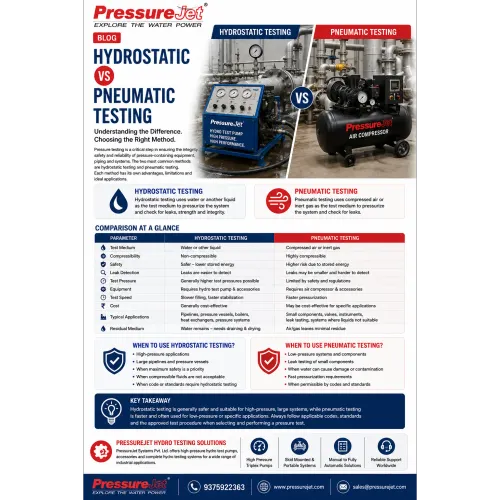
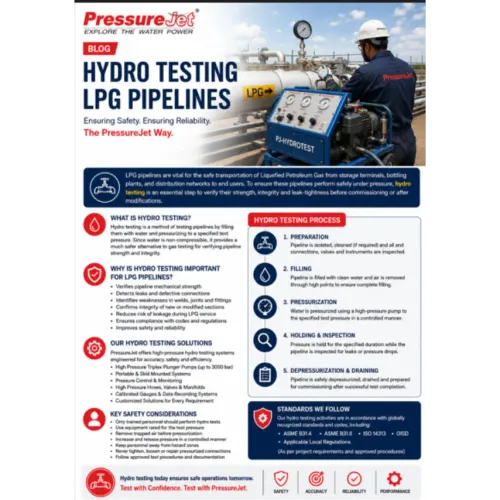
Hydrostatic testing is widely used for pipeline integrity verification and is commonly performed before placing newly constructed pipelines into service.
For EPC contractors, the objective is therefore not simply:
'Complete the hydro test.'
It is:
'Complete a technically valid, safe, documented and client-acceptable hydro test without affecting the project schedule.'
Major EPC Applications of Hydro Testing
Hydro testing can form part of commissioning or pre-commissioning activities for many EPC projects.
Oil & Gas Projects
Process piping
Hydrocarbon pipelines
Gas pipelines
LPG systems
Storage facilities
Pressure vessels
Manifolds
Valve assemblies
Petrochemical Projects
Process piping
Reactors
Heat exchangers
Condensers
Pressure vessels
Utility systems
Power Projects
Boiler-related piping
Steam and water systems
Condensate systems
Cooling-water systems
High-pressure piping
Water & Infrastructure Projects
Water transmission pipelines
Pumping stations
Treatment plants
Industrial water systems
Fire-water networks
Chemical & Pharmaceutical Projects
Process piping
Utility piping
Pressure equipment
Heat exchangers
Specialized process systems
Hydro Testing Challenges Faced by EPC Contractors
1. Large Number of Test Packages
Large EPC projects may contain hundreds of individual piping and equipment test packages.
Each package can have its own:
Test boundary
Test pressure
Test volume
Test medium
Test procedure
Instrumentation
Inspection requirements
Documentation
A well-organized test-package strategy is therefore essential.
2. Hydro Test Boundaries
Incorrect test boundaries can create serious problems.
Before testing, the EPC team must establish exactly:
Which piping is included?
Which equipment is included?
Which components must be isolated?
Which instruments must be removed or protected?
Where are the test blinds?
Where are the pressure gauges installed?
Where are vents and drains located?
The test boundary should be reviewed and approved before pressurization.
3. Equipment Protection
Not every component connected to the system is necessarily suitable for the planned test pressure.
Depending on the project design and procedure, equipment such as:
Control valves
Instruments
Relief valves
Expansion joints
Sight glasses
Rotating equipment
Sensitive instrumentation
may need to be removed, isolated, or otherwise protected.
This should be addressed during test-package preparation rather than discovered at the testing stage.
4. Water Management
Large EPC projects can require significant quantities of water for hydro testing.
The contractor must plan for:
Water Source → Filtration/Treatment → Filling → Testing → Dewatering → Disposal
Water quality may also be important depending on the material and service.
For example, certain applications may require controls on contaminants such as chlorides to reduce corrosion risks. The actual water specification should come from the project specification and applicable engineering requirements.
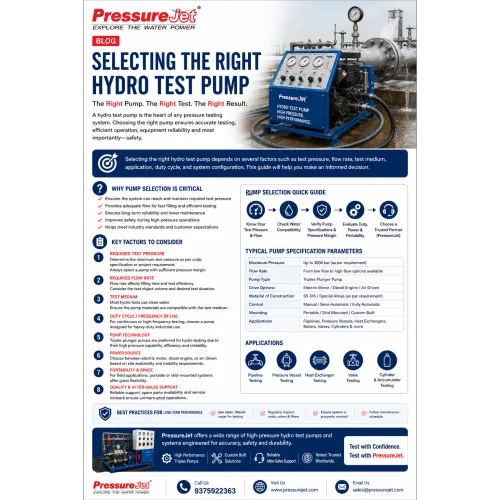
5. Test Pump Selection
The hydro test pump is one of the most important pieces of equipment in the testing setup.
The pump should be selected based on:
Required test pressure
Required flow rate
Test volume
Number of test packages
Test cycle time
Available power
Site conditions
Portability requirements
Automation requirements
For high-pressure applications, triplex plunger pumps are commonly used because of their high-pressure capability and robust construction.
A pump that is too small may significantly increase testing time, while an incorrectly selected pump or pressure-control system can create operational and safety problems.
6. Pressure & Temperature Monitoring
Pressure should not be evaluated in isolation.
During hydro testing, pressure behavior can be influenced by factors such as:
Temperature
Fluid compressibility
Pipeline expansion
Elevation
Entrapped air
Instrument accuracy
Recent industry guidance emphasizes that a technically defensible hydrostatic test depends on measurement quality, calibration, temperature correlation, volume considerations, and engineering evaluation—not simply on reaching a target pressure.
For critical EPC projects, appropriate pressure and temperature recording can therefore be an important part of the test documentation.
EPC Hydro Testing Workflow
A well-planned hydro testing process can generally be organized into the following stages.
Step 1: Engineering Review
Review:
P& IDs
Isometric drawings
Line lists
Equipment datasheets
Design pressures
Test requirements
Applicable codes
Project specifications
ASME B31.3, for example, covers process piping and is specifically relevant to engineers, managers and quality personnel involved in process-piping projects.
Step 2: Prepare Hydro Test Packages
Divide the system into practical test sections.
Each package should clearly identify:
Test boundary
Test pressure
Test medium
Test volume
Test duration
Required instruments
Test equipment
Vents and drains
Temporary blinds
Acceptance criteria
Responsible personnel
Step 3: Construction Completion Check
Before hydro testing, verify that construction activities relevant to the test package are complete.
Typical checks may include:
Welding completion
NDT completion
Weld repair completion
Flange installation
Valve installation
Supports completion
Punch-list review
Inspection clearance
Hydro testing should not become a substitute for proper construction quality control.
Step 4: Test Equipment Installation
Install the required:
High-pressure hydro test pump
Filling pump, where required
Pressure gauges
Pressure transmitters
Pressure recorder/data logger
Test manifold
Hoses
Isolation valves
Relief/protection arrangements
Pressure instruments should have current calibration records appropriate to the project requirements. Guidance for pipeline testing also recommends calibrated pressure gauges and recording instrumentation.
Step 5: Filling & Air Removal
The test section is filled with the approved test medium.
Trapped air should be removed through appropriate high-point vents and other approved arrangements.
Effective air removal is important for both test accuracy and safety. Industry guidance specifically emphasizes eliminating trapped air before pressurization.
Step 6: Controlled Pressurization
The pressure should be increased according to the approved procedure.
The system should not simply be taken from zero to full test pressure as quickly as possible.
Controlled pressurization allows the testing team to monitor the system for abnormal behavior and identify potential problems before reaching the final test pressure.
Step 7: Pressure Holding & Inspection
Once the specified test pressure is reached, the pressure is held for the duration defined by the applicable code and project procedure.
During this period, the team may monitor:
Pressure
Temperature
Time
Visible leakage
Welds
Flanges
Valves
Fittings
Connections
Other relevant test points
The required pressure and holding period should never be assumed from a generic table. They must come from the governing code, project specification and approved procedure.
Step 8: Test Evaluation
The test data should be evaluated against the predetermined acceptance criteria.
A successful test is not simply a pressure gauge showing the desired value.
Pressure behavior should be assessed in the context of:
Temperature changes
Instrument accuracy
Test volume
System expansion
Elevation
Known system characteristics
Any observed leakage
Recent pipeline-industry analysis highlights that pressure stability alone does not prove leak-tightness and that temperature, volume and instrumentation should be considered in the engineering evaluation.
Step 9: Depressurization & Dewatering
After successful acceptance, the system should be depressurized in a controlled manner.
The test water is then removed through the approved dewatering procedure.
Depending on the service, material and project requirements, the system may also require:
Drying
Air blowing
Nitrogen drying
Dew point verification
Environmental requirements for test-water discharge must also be considered.
Step 10: Documentation & Client Handover
Documentation is particularly important for EPC contractors.
A hydro test dossier may include:
Approved hydro test procedure
Test package
P& ID/isometric references
Test boundary drawings
Equipment calibration certificates
Pressure charts
Temperature records
Test certificates
Inspection reports
Punch-list status
Water-quality records where required
Dewatering records
Client/third-party inspection records
Final acceptance documentation
ASME training material for pipeline pressure testing specifically identifies planning, implementation, permitting, preparation, testing, return to service, and documentation as important parts of pressure-test execution.
How EPC Contractors Can Reduce Hydro Testing Time
Hydro testing is often on the critical path for commissioning.
The following strategies can improve productivity.
1. Start Hydro Test Planning Early
Do not wait until mechanical completion to start developing test packages.
2. Optimize Test Sections
Test boundaries should balance:
Test volume + available equipment + site logistics + safety + commissioning sequence.
3. Use Appropriate Pump Capacity
The correct pressure and flow combination can significantly reduce filling and pressurization time.
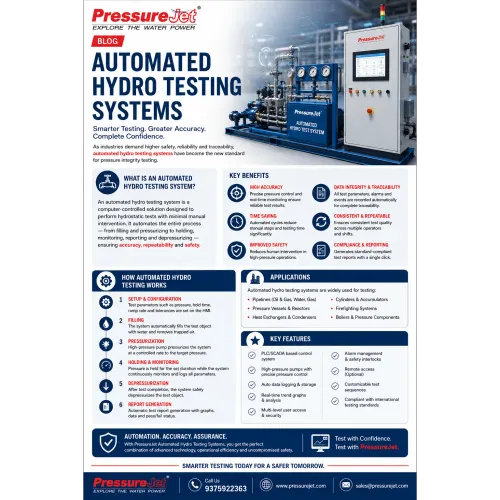
4. Use Automated Hydro Testing
For repetitive testing, automation can provide:
Automatic pressure control
Programmable sequences
Data logging
Pressure trend monitoring
Automatic reporting
Improved repeatability
5. Maintain Calibration Records
Avoid delays caused by expired or missing calibration certificates.
6. Plan Water Logistics
Water supply, storage, treatment, filling, drainage and disposal should be planned before testing begins.
7. Coordinate With Other Site Activities
Hydro testing requires controlled access and may affect nearby construction activities. Test schedules should therefore be integrated into the overall EPC construction and commissioning plan.
Hydro Testing Safety for EPC Contractors
Hydro testing involves significant stored energy and must be treated as a safety-critical activity.
Before pressurization:
Establish an exclusion zone.
Confirm test boundaries.
Verify temporary closures and restraints.
Check pressure ratings of all components.
Confirm instrument calibration.
Remove trapped air.
Brief all personnel.
Control access to the test area.
Ensure the approved procedure is available at site.
Personnel should never attempt to tighten, loosen, repair or manipulate pressure-containing connections while the system is pressurized.
Pipeline testing guidance also recommends maintaining an exclusion zone, using certified/calibrated instrumentation, controlling pressurization, and keeping unauthorized personnel away from the test area.
Benefits of a Professional Hydro Test System for EPC Projects
A properly engineered hydro testing system can provide:
Faster Testing
Appropriate pump flow can reduce filling and pressurization time.
Better Pressure Control
Accurate pressure control improves the consistency of the test.
Improved Safety
Suitable equipment, instrumentation and controlled pressurization reduce operational risks.
Better Documentation
Digital data acquisition can simplify test reporting and traceability.
Higher Productivity
Standardized testing systems can help EPC contractors manage multiple test packages more efficiently.
Easier Client Acceptance
Complete and well-organized documentation makes inspection and handover more efficient.
PressureJet Hydro Testing Solutions for EPC Contractors
PressureJet Systems Pvt. Ltd. provides high-pressure pumps and hydro testing systems designed for industrial pressure-testing applications.
For EPC projects, systems can be configured according to:
Test pressure
Flow requirement
Test volume
Number of test packages
Duty cycle
Site conditions
Power availability
Portability requirements
Instrumentation requirements
Automation level
Available Solutions
High-Pressure Triplex Plunger Pumps
For demanding hydrostatic pressure testing applications.
Portable Hydro Test Units
Suitable for field testing and multiple test locations.
Skid-Mounted Hydro Test Systems
Designed for dedicated plant and project testing stations.
Automated Hydro Testing Systems
For repeatable testing, pressure control, data logging and automated reporting.
Complete Hydro Test Packages
Including pumps, manifolds, valves, hoses, gauges, instrumentation and control systems according to project requirements.
EPC Hydro Testing Checklist
Before starting a hydro test, the project team should verify:
Test package approved
Test boundary confirmed
Construction completion confirmed
NDT requirements completed
Test pressure established
Test medium approved
Water supply arranged
Pump capacity verified
Pressure equipment rated appropriately
Gauges calibrated
Data recorder available
Vents and drains identified
Temporary blinds/closures verified
Air removal arrangement confirmed
Safety exclusion zone established
Work permit completed
Inspection/client representative available
Test procedure available at site
Dewatering plan established
Documentation format agreed
Conclusion
For EPC contractors, hydro testing is a project-management, engineering, quality, safety and commissioning activity—not simply a pressure test.
The most successful hydro testing programs are planned well before field execution. They combine properly defined test packages, suitable test equipment, calibrated instrumentation, trained personnel, effective water management, controlled pressurization, engineering evaluation and complete documentation.
A reliable hydro test system can help EPC contractors achieve the three objectives that matter most:
Safety + Schedule + Quality
With the right planning and the right equipment, hydro testing can become a controlled project milestone rather than a last-minute commissioning bottleneck.
Test With Confidence. Test With PressureJet.
PressureJet Systems Pvt. Ltd.
High Pressure Pumps & Hydro Testing Systems
📞 9375922363
🌐 www.pressurejet.com
✉️ sales@pressurejet.com
A properly planned hydro test helps demonstrate that the completed system can withstand the specified test conditions and is sufficiently leak-tight for its intended service. For EPC contractors, successful hydro testing also has a direct impact on project schedule, quality assurance, safety, commissioning, documentation, and client handover.
The challenge is that hydro testing often takes place near the end of construction, when multiple project activities are competing for manpower, equipment, utilities, and access. Poor planning can therefore turn hydro testing into a major source of project delays.
Why Hydro Testing Is Critical for EPC Projects
EPC projects typically involve thousands of individual components, weld joints, valves, fittings, equipment connections, and piping sections.
Before these systems are commissioned, the EPC contractor must establish that the relevant pressure-containing systems have been properly tested according to the applicable engineering requirements.
Hydro testing can help identify:
Leaking welds
Defective flanges and joints
Incorrectly installed components
Weak connections
Pressure-boundary defects
Construction-related deficiencies
Leakage from valves and fittings
Hydrostatic testing is widely used for pipeline integrity verification and is commonly performed before placing newly constructed pipelines into service.
For EPC contractors, the objective is therefore not simply:
'Complete the hydro test.'
It is:
'Complete a technically valid, safe, documented and client-acceptable hydro test without affecting the project schedule.'
Major EPC Applications of Hydro Testing
Hydro testing can form part of commissioning or pre-commissioning activities for many EPC projects.
Oil & Gas Projects
Process piping
Hydrocarbon pipelines
Gas pipelines
LPG systems
Storage facilities
Pressure vessels
Manifolds
Valve assemblies
Petrochemical Projects
Process piping
Reactors
Heat exchangers
Condensers
Pressure vessels
Utility systems
Power Projects
Boiler-related piping
Steam and water systems
Condensate systems
Cooling-water systems
High-pressure piping
Water & Infrastructure Projects
Water transmission pipelines
Pumping stations
Treatment plants
Industrial water systems
Fire-water networks
Chemical & Pharmaceutical Projects
Process piping
Utility piping
Pressure equipment
Heat exchangers
Specialized process systems
Hydro Testing Challenges Faced by EPC Contractors
1. Large Number of Test Packages
Large EPC projects may contain hundreds of individual piping and equipment test packages.
Each package can have its own:
Test boundary
Test pressure
Test volume
Test medium
Test procedure
Instrumentation
Inspection requirements
Documentation
A well-organized test-package strategy is therefore essential.
2. Hydro Test Boundaries
Incorrect test boundaries can create serious problems.
Before testing, the EPC team must establish exactly:
Which piping is included?
Which equipment is included?
Which components must be isolated?
Which instruments must be removed or protected?
Where are the test blinds?
Where are the pressure gauges installed?
Where are vents and drains located?
The test boundary should be reviewed and approved before pressurization.
3. Equipment Protection
Not every component connected to the system is necessarily suitable for the planned test pressure.
Depending on the project design and procedure, equipment such as:
Control valves
Instruments
Relief valves
Expansion joints
Sight glasses
Rotating equipment
Sensitive instrumentation
may need to be removed, isolated, or otherwise protected.
This should be addressed during test-package preparation rather than discovered at the testing stage.
4. Water Management
Large EPC projects can require significant quantities of water for hydro testing.
The contractor must plan for:
Water Source → Filtration/Treatment → Filling → Testing → Dewatering → Disposal
Water quality may also be important depending on the material and service.
For example, certain applications may require controls on contaminants such as chlorides to reduce corrosion risks. The actual water specification should come from the project specification and applicable engineering requirements.
5. Test Pump Selection
The hydro test pump is one of the most important pieces of equipment in the testing setup.
The pump should be selected based on:
Required test pressure
Required flow rate
Test volume
Number of test packages
Test cycle time
Available power
Site conditions
Portability requirements
Automation requirements
For high-pressure applications, triplex plunger pumps are commonly used because of their high-pressure capability and robust construction.
A pump that is too small may significantly increase testing time, while an incorrectly selected pump or pressure-control system can create operational and safety problems.
6. Pressure & Temperature Monitoring
Pressure should not be evaluated in isolation.
During hydro testing, pressure behavior can be influenced by factors such as:
Temperature
Fluid compressibility
Pipeline expansion
Elevation
Entrapped air
Instrument accuracy
Recent industry guidance emphasizes that a technically defensible hydrostatic test depends on measurement quality, calibration, temperature correlation, volume considerations, and engineering evaluation—not simply on reaching a target pressure.
For critical EPC projects, appropriate pressure and temperature recording can therefore be an important part of the test documentation.
EPC Hydro Testing Workflow
A well-planned hydro testing process can generally be organized into the following stages.
Step 1: Engineering Review
Review:
P& IDs
Isometric drawings
Line lists
Equipment datasheets
Design pressures
Test requirements
Applicable codes
Project specifications
ASME B31.3, for example, covers process piping and is specifically relevant to engineers, managers and quality personnel involved in process-piping projects.
Step 2: Prepare Hydro Test Packages
Divide the system into practical test sections.
Each package should clearly identify:
Test boundary
Test pressure
Test medium
Test volume
Test duration
Required instruments
Test equipment
Vents and drains
Temporary blinds
Acceptance criteria
Responsible personnel
Step 3: Construction Completion Check
Before hydro testing, verify that construction activities relevant to the test package are complete.
Typical checks may include:
Welding completion
NDT completion
Weld repair completion
Flange installation
Valve installation
Supports completion
Punch-list review
Inspection clearance
Hydro testing should not become a substitute for proper construction quality control.
Step 4: Test Equipment Installation
Install the required:
High-pressure hydro test pump
Filling pump, where required
Pressure gauges
Pressure transmitters
Pressure recorder/data logger
Test manifold
Hoses
Isolation valves
Relief/protection arrangements
Pressure instruments should have current calibration records appropriate to the project requirements. Guidance for pipeline testing also recommends calibrated pressure gauges and recording instrumentation.
Step 5: Filling & Air Removal
The test section is filled with the approved test medium.
Trapped air should be removed through appropriate high-point vents and other approved arrangements.
Effective air removal is important for both test accuracy and safety. Industry guidance specifically emphasizes eliminating trapped air before pressurization.
Step 6: Controlled Pressurization
The pressure should be increased according to the approved procedure.
The system should not simply be taken from zero to full test pressure as quickly as possible.
Controlled pressurization allows the testing team to monitor the system for abnormal behavior and identify potential problems before reaching the final test pressure.
Step 7: Pressure Holding & Inspection
Once the specified test pressure is reached, the pressure is held for the duration defined by the applicable code and project procedure.
During this period, the team may monitor:
Pressure
Temperature
Time
Visible leakage
Welds
Flanges
Valves
Fittings
Connections
Other relevant test points
The required pressure and holding period should never be assumed from a generic table. They must come from the governing code, project specification and approved procedure.
Step 8: Test Evaluation
The test data should be evaluated against the predetermined acceptance criteria.
A successful test is not simply a pressure gauge showing the desired value.
Pressure behavior should be assessed in the context of:
Temperature changes
Instrument accuracy
Test volume
System expansion
Elevation
Known system characteristics
Any observed leakage
Recent pipeline-industry analysis highlights that pressure stability alone does not prove leak-tightness and that temperature, volume and instrumentation should be considered in the engineering evaluation.
Step 9: Depressurization & Dewatering
After successful acceptance, the system should be depressurized in a controlled manner.
The test water is then removed through the approved dewatering procedure.
Depending on the service, material and project requirements, the system may also require:
Drying
Air blowing
Nitrogen drying
Dew point verification
Environmental requirements for test-water discharge must also be considered.
Step 10: Documentation & Client Handover
Documentation is particularly important for EPC contractors.
A hydro test dossier may include:
Approved hydro test procedure
Test package
P& ID/isometric references
Test boundary drawings
Equipment calibration certificates
Pressure charts
Temperature records
Test certificates
Inspection reports
Punch-list status
Water-quality records where required
Dewatering records
Client/third-party inspection records
Final acceptance documentation
ASME training material for pipeline pressure testing specifically identifies planning, implementation, permitting, preparation, testing, return to service, and documentation as important parts of pressure-test execution.
How EPC Contractors Can Reduce Hydro Testing Time
Hydro testing is often on the critical path for commissioning.
The following strategies can improve productivity.
1. Start Hydro Test Planning Early
Do not wait until mechanical completion to start developing test packages.
2. Optimize Test Sections
Test boundaries should balance:
Test volume + available equipment + site logistics + safety + commissioning sequence.
3. Use Appropriate Pump Capacity
The correct pressure and flow combination can significantly reduce filling and pressurization time.
4. Use Automated Hydro Testing
For repetitive testing, automation can provide:
Automatic pressure control
Programmable sequences
Data logging
Pressure trend monitoring
Automatic reporting
Improved repeatability
5. Maintain Calibration Records
Avoid delays caused by expired or missing calibration certificates.
6. Plan Water Logistics
Water supply, storage, treatment, filling, drainage and disposal should be planned before testing begins.
7. Coordinate With Other Site Activities
Hydro testing requires controlled access and may affect nearby construction activities. Test schedules should therefore be integrated into the overall EPC construction and commissioning plan.
Hydro Testing Safety for EPC Contractors
Hydro testing involves significant stored energy and must be treated as a safety-critical activity.
Before pressurization:
Establish an exclusion zone.
Confirm test boundaries.
Verify temporary closures and restraints.
Check pressure ratings of all components.
Confirm instrument calibration.
Remove trapped air.
Brief all personnel.
Control access to the test area.
Ensure the approved procedure is available at site.
Personnel should never attempt to tighten, loosen, repair or manipulate pressure-containing connections while the system is pressurized.
Pipeline testing guidance also recommends maintaining an exclusion zone, using certified/calibrated instrumentation, controlling pressurization, and keeping unauthorized personnel away from the test area.
Benefits of a Professional Hydro Test System for EPC Projects
A properly engineered hydro testing system can provide:
Faster Testing
Appropriate pump flow can reduce filling and pressurization time.
Better Pressure Control
Accurate pressure control improves the consistency of the test.
Improved Safety
Suitable equipment, instrumentation and controlled pressurization reduce operational risks.
Better Documentation
Digital data acquisition can simplify test reporting and traceability.
Higher Productivity
Standardized testing systems can help EPC contractors manage multiple test packages more efficiently.
Easier Client Acceptance
Complete and well-organized documentation makes inspection and handover more efficient.
PressureJet Hydro Testing Solutions for EPC Contractors
PressureJet Systems Pvt. Ltd. provides high-pressure pumps and hydro testing systems designed for industrial pressure-testing applications.
For EPC projects, systems can be configured according to:
Test pressure
Flow requirement
Test volume
Number of test packages
Duty cycle
Site conditions
Power availability
Portability requirements
Instrumentation requirements
Automation level
Available Solutions
High-Pressure Triplex Plunger Pumps
For demanding hydrostatic pressure testing applications.
Portable Hydro Test Units
Suitable for field testing and multiple test locations.
Skid-Mounted Hydro Test Systems
Designed for dedicated plant and project testing stations.
Automated Hydro Testing Systems
For repeatable testing, pressure control, data logging and automated reporting.
Complete Hydro Test Packages
Including pumps, manifolds, valves, hoses, gauges, instrumentation and control systems according to project requirements.
EPC Hydro Testing Checklist
Before starting a hydro test, the project team should verify:
Test package approved
Test boundary confirmed
Construction completion confirmed
NDT requirements completed
Test pressure established
Test medium approved
Water supply arranged
Pump capacity verified
Pressure equipment rated appropriately
Gauges calibrated
Data recorder available
Vents and drains identified
Temporary blinds/closures verified
Air removal arrangement confirmed
Safety exclusion zone established
Work permit completed
Inspection/client representative available
Test procedure available at site
Dewatering plan established
Documentation format agreed
Conclusion
For EPC contractors, hydro testing is a project-management, engineering, quality, safety and commissioning activity—not simply a pressure test.
The most successful hydro testing programs are planned well before field execution. They combine properly defined test packages, suitable test equipment, calibrated instrumentation, trained personnel, effective water management, controlled pressurization, engineering evaluation and complete documentation.
A reliable hydro test system can help EPC contractors achieve the three objectives that matter most:
Safety + Schedule + Quality
With the right planning and the right equipment, hydro testing can become a controlled project milestone rather than a last-minute commissioning bottleneck.
Test With Confidence. Test With PressureJet.
PressureJet Systems Pvt. Ltd.
High Pressure Pumps & Hydro Testing Systems
📞 9375922363
🌐 www.pressurejet.com
✉️ sales@pressurejet.com
Keywords