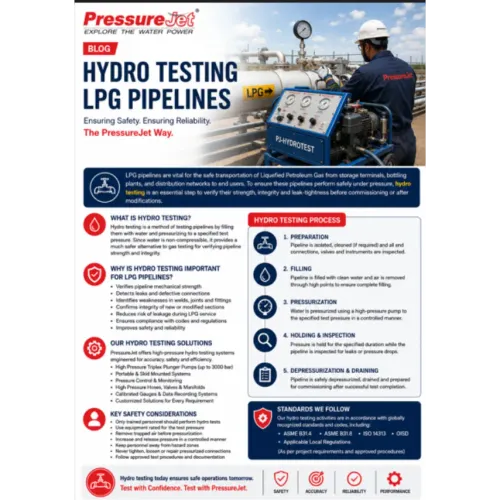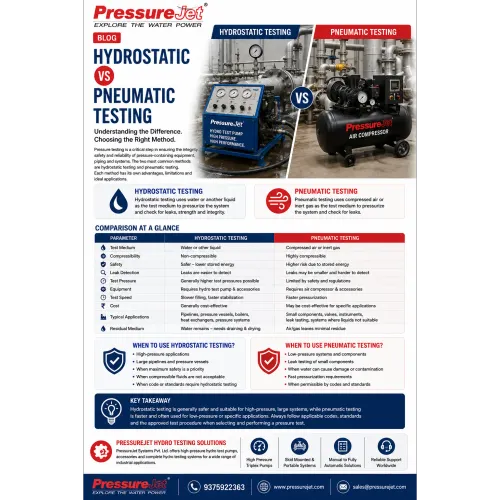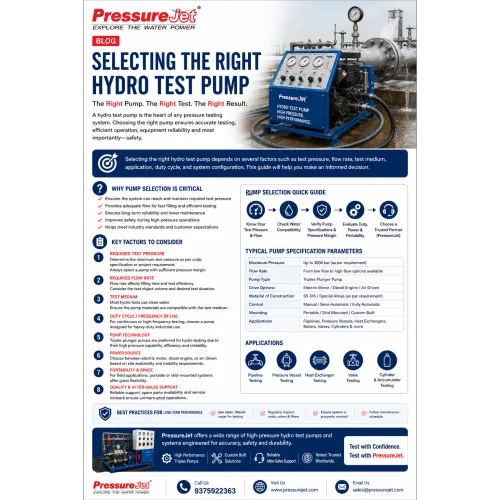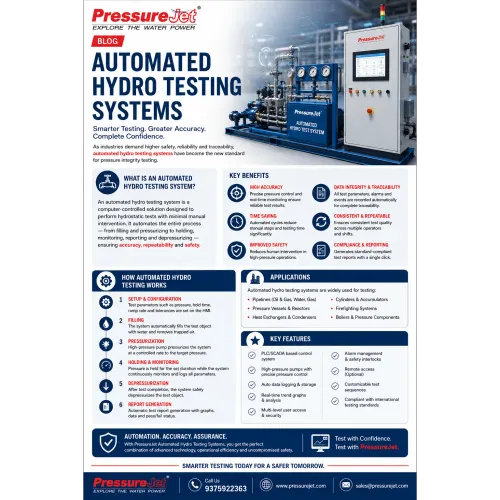
Hydro testing is one of the most widely used methods for verifying the integrity, strength, and leak-tightness of pressure-containing equipment such as pipelines, pressure vessels, heat exchangers, boilers, storage tanks, and valves. While significant attention is often given to test pressure, equipment selection, and testing procedures, one critical factor is frequently overlooked: the quality of water used during hydro testing.
Using poor-quality water can lead to corrosion, scaling, contamination, equipment damage, and inaccurate test results. At PressureJet Systems Pvt. Ltd., we emphasize the importance of selecting the appropriate water quality to ensure reliable testing and long-term asset protection.
Why Water Quality Matters in Hydro Testing
The water used during hydro testing comes into direct contact with internal surfaces of equipment and piping systems. If the water contains excessive impurities, dissolved salts, bacteria, or suspended solids, it can adversely affect the equipment being tested.
Poor water quality may result in:
Internal corrosion
Pitting damage
Scale formation
Microbiologically Influenced Corrosion (MIC)
Contamination of process equipment
Reduced equipment life
Increased maintenance costs
Therefore, selecting the right water quality is as important as choosing the right hydro test pump.
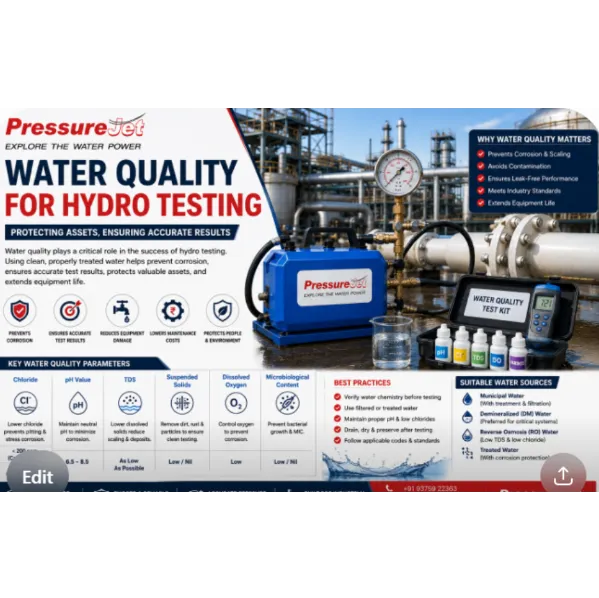
Key Water Quality Parameters for Hydro Testing
1. Chloride Content
Chlorides are one of the most critical parameters, especially when testing stainless steel equipment.
High chloride levels can cause:
Stress corrosion cracking
Pitting corrosion
Surface degradation
Recommended Chloride Limits
Material Typical Chloride Limit
Carbon Steel < 200 ppm
Stainless Steel < 50 ppm
Duplex Stainless Steel As per project specification
Many project specifications require chloride levels below 25–50 ppm for stainless steel systems.
2. pH Value
The pH of hydro test water influences corrosion behavior.
Recommended Range
pH 6.5 to 8.5
Water that is too acidic or too alkaline can accelerate corrosion and damage internal surfaces.
3. Total Dissolved Solids (TDS)
TDS represents dissolved salts and minerals present in water.
High TDS may cause:
Corrosion
Deposits
Scaling
Contamination
Lower TDS water is generally preferred for critical applications.
4. Suspended Solids
Water should be free from excessive dirt, rust particles, sand, and debris.
Excessive suspended solids can:
Block valves
Damage instrumentation
Cause erosion
Leave deposits inside equipment
Filtration is often recommended before testing.
5. Dissolved Oxygen
Oxygen promotes corrosion in carbon steel systems.
For critical applications:
Oxygen scavengers may be added
Deaerated water may be used
particularly for boilers and high-pressure systems.
6. Microbiological Content
Untreated water can contain bacteria that contribute to:
Biofilm formation
Microbiologically Influenced Corrosion (MIC)
Internal contamination
This is especially important for long-duration hydro tests.
Water Sources Used for Hydro Testing
Municipal Water
Advantages:
✔ Easily available
✔ Cost-effective
Limitations:
May require filtration
Chloride content should be verified
Demineralized (DM) Water
Advantages:
✔ Very low dissolved solids
✔ Minimal corrosion risk
✔ Preferred for critical equipment
Commonly used for:
Boilers
Heat exchangers
Stainless steel systems
Reverse Osmosis (RO) Water
Advantages:
✔ Reduced mineral content
✔ Lower chloride levels
✔ Improved water quality
Suitable for many industrial hydro testing applications.
Treated Water
Chemical treatment may be used to control:
Corrosion
Scaling
Bacterial growth
particularly during extended testing periods.
Water Quality Requirements by Equipment Type
Pipelines
Focus on:
Chloride control
Cleanliness
Proper drying after testing
Heat Exchangers
Require:
Low chlorides
Low suspended solids
Corrosion protection
Boilers
Require:
Demineralized water
Controlled oxygen levels
Strict water chemistry
Storage Tanks
Typically use clean filtered water with appropriate corrosion controls.
Valves and Pressure Vessels
Require clean, non-corrosive water compatible with construction materials.
Importance of Post-Test Water Removal
Even high-quality hydro test water can become harmful if left inside equipment after testing.
Post-Test Activities Include:
✔ Complete draining
✔ Air blowing
✔ Nitrogen drying
✔ Chemical preservation
✔ Corrosion inhibitor application
Proper drying is particularly important for:
Stainless steel systems
Heat exchangers
Boilers
Process piping
Common Problems Caused by Poor Water Quality
Pitting Corrosion
Localized attack resulting in deep cavities.
Scaling
Mineral deposits reduce equipment efficiency.
Stress Corrosion Cracking
Particularly dangerous for stainless steels.
Biological Growth
Can lead to long-term corrosion issues.
Contamination
May affect future process operations and product quality.
PressureJet's Approach to Hydro Testing
At PressureJet Systems Pvt. Ltd., we understand that successful hydro testing depends not only on reliable pressure generation but also on proper testing practices and water quality management.
Our hydro testing solutions support:
✔ Pipelines
✔ Pressure Vessels
✔ Heat Exchangers
✔ Boilers
✔ Storage Tanks
✔ Valves
✔ Power Plants
✔ Chemical & Petrochemical Facilities
Our engineering team assists customers in selecting suitable hydro testing systems and best practices for safe, compliant, and effective testing.
Best Practices for Hydro Test Water Quality
Before Testing
Verify water chemistry
Check chloride levels
Filter suspended solids
Confirm pH range
During Testing
Maintain cleanliness
Prevent contamination
Monitor water condition
After Testing
Drain completely
Dry thoroughly
Apply preservation measures if required
Conclusion
Water quality plays a crucial role in the success of hydro testing. Using clean, properly treated water helps prevent corrosion, ensures accurate test results, protects valuable assets, and extends equipment life. Whether testing pipelines, boilers, heat exchangers, storage tanks, or pressure vessels, selecting the right water quality is essential for achieving reliable and safe outcomes.
With decades of expertise in high-pressure water technology, PressureJet Systems Pvt. Ltd. continues to support industries worldwide with dependable hydro testing solutions and engineering excellence.
About PressureJet Systems Pvt. Ltd.
PressureJet Systems Pvt. Ltd. is a leading manufacturer of High-Pressure Pumps, Hydro Test Units, Hydro Jetting Systems, Tube Cleaning Equipment, and Industrial Pressure Solutions serving industries including oil & gas, petrochemicals, power generation, chemicals, water treatment, manufacturing, and infrastructure.
Contact Us
📞 +91 93759 22363
📧 sales@pressurejet.com
🌐 www.pressurejet.com
Using poor-quality water can lead to corrosion, scaling, contamination, equipment damage, and inaccurate test results. At PressureJet Systems Pvt. Ltd., we emphasize the importance of selecting the appropriate water quality to ensure reliable testing and long-term asset protection.
Why Water Quality Matters in Hydro Testing
The water used during hydro testing comes into direct contact with internal surfaces of equipment and piping systems. If the water contains excessive impurities, dissolved salts, bacteria, or suspended solids, it can adversely affect the equipment being tested.
Poor water quality may result in:
Internal corrosion
Pitting damage
Scale formation
Microbiologically Influenced Corrosion (MIC)
Contamination of process equipment
Reduced equipment life
Increased maintenance costs
Therefore, selecting the right water quality is as important as choosing the right hydro test pump.
Key Water Quality Parameters for Hydro Testing
1. Chloride Content
Chlorides are one of the most critical parameters, especially when testing stainless steel equipment.
High chloride levels can cause:
Stress corrosion cracking
Pitting corrosion
Surface degradation
Recommended Chloride Limits
Material Typical Chloride Limit
Carbon Steel < 200 ppm
Stainless Steel < 50 ppm
Duplex Stainless Steel As per project specification
Many project specifications require chloride levels below 25–50 ppm for stainless steel systems.
2. pH Value
The pH of hydro test water influences corrosion behavior.
Recommended Range
pH 6.5 to 8.5
Water that is too acidic or too alkaline can accelerate corrosion and damage internal surfaces.
3. Total Dissolved Solids (TDS)
TDS represents dissolved salts and minerals present in water.
High TDS may cause:
Corrosion
Deposits
Scaling
Contamination
Lower TDS water is generally preferred for critical applications.
4. Suspended Solids
Water should be free from excessive dirt, rust particles, sand, and debris.
Excessive suspended solids can:
Block valves
Damage instrumentation
Cause erosion
Leave deposits inside equipment
Filtration is often recommended before testing.
5. Dissolved Oxygen
Oxygen promotes corrosion in carbon steel systems.
For critical applications:
Oxygen scavengers may be added
Deaerated water may be used
particularly for boilers and high-pressure systems.
6. Microbiological Content
Untreated water can contain bacteria that contribute to:
Biofilm formation
Microbiologically Influenced Corrosion (MIC)
Internal contamination
This is especially important for long-duration hydro tests.
Water Sources Used for Hydro Testing
Municipal Water
Advantages:
✔ Easily available
✔ Cost-effective
Limitations:
May require filtration
Chloride content should be verified
Demineralized (DM) Water
Advantages:
✔ Very low dissolved solids
✔ Minimal corrosion risk
✔ Preferred for critical equipment
Commonly used for:
Boilers
Heat exchangers
Stainless steel systems
Reverse Osmosis (RO) Water
Advantages:
✔ Reduced mineral content
✔ Lower chloride levels
✔ Improved water quality
Suitable for many industrial hydro testing applications.
Treated Water
Chemical treatment may be used to control:
Corrosion
Scaling
Bacterial growth
particularly during extended testing periods.
Water Quality Requirements by Equipment Type
Pipelines
Focus on:
Chloride control
Cleanliness
Proper drying after testing
Heat Exchangers
Require:
Low chlorides
Low suspended solids
Corrosion protection
Boilers
Require:
Demineralized water
Controlled oxygen levels
Strict water chemistry
Storage Tanks
Typically use clean filtered water with appropriate corrosion controls.
Valves and Pressure Vessels
Require clean, non-corrosive water compatible with construction materials.
Importance of Post-Test Water Removal
Even high-quality hydro test water can become harmful if left inside equipment after testing.
Post-Test Activities Include:
✔ Complete draining
✔ Air blowing
✔ Nitrogen drying
✔ Chemical preservation
✔ Corrosion inhibitor application
Proper drying is particularly important for:
Stainless steel systems
Heat exchangers
Boilers
Process piping
Common Problems Caused by Poor Water Quality
Pitting Corrosion
Localized attack resulting in deep cavities.
Scaling
Mineral deposits reduce equipment efficiency.
Stress Corrosion Cracking
Particularly dangerous for stainless steels.
Biological Growth
Can lead to long-term corrosion issues.
Contamination
May affect future process operations and product quality.
PressureJet's Approach to Hydro Testing
At PressureJet Systems Pvt. Ltd., we understand that successful hydro testing depends not only on reliable pressure generation but also on proper testing practices and water quality management.
Our hydro testing solutions support:
✔ Pipelines
✔ Pressure Vessels
✔ Heat Exchangers
✔ Boilers
✔ Storage Tanks
✔ Valves
✔ Power Plants
✔ Chemical & Petrochemical Facilities
Our engineering team assists customers in selecting suitable hydro testing systems and best practices for safe, compliant, and effective testing.
Best Practices for Hydro Test Water Quality
Before Testing
Verify water chemistry
Check chloride levels
Filter suspended solids
Confirm pH range
During Testing
Maintain cleanliness
Prevent contamination
Monitor water condition
After Testing
Drain completely
Dry thoroughly
Apply preservation measures if required
Conclusion
Water quality plays a crucial role in the success of hydro testing. Using clean, properly treated water helps prevent corrosion, ensures accurate test results, protects valuable assets, and extends equipment life. Whether testing pipelines, boilers, heat exchangers, storage tanks, or pressure vessels, selecting the right water quality is essential for achieving reliable and safe outcomes.
With decades of expertise in high-pressure water technology, PressureJet Systems Pvt. Ltd. continues to support industries worldwide with dependable hydro testing solutions and engineering excellence.
About PressureJet Systems Pvt. Ltd.
PressureJet Systems Pvt. Ltd. is a leading manufacturer of High-Pressure Pumps, Hydro Test Units, Hydro Jetting Systems, Tube Cleaning Equipment, and Industrial Pressure Solutions serving industries including oil & gas, petrochemicals, power generation, chemicals, water treatment, manufacturing, and infrastructure.
Contact Us
📞 +91 93759 22363
📧 sales@pressurejet.com
🌐 www.pressurejet.com
Keywords